
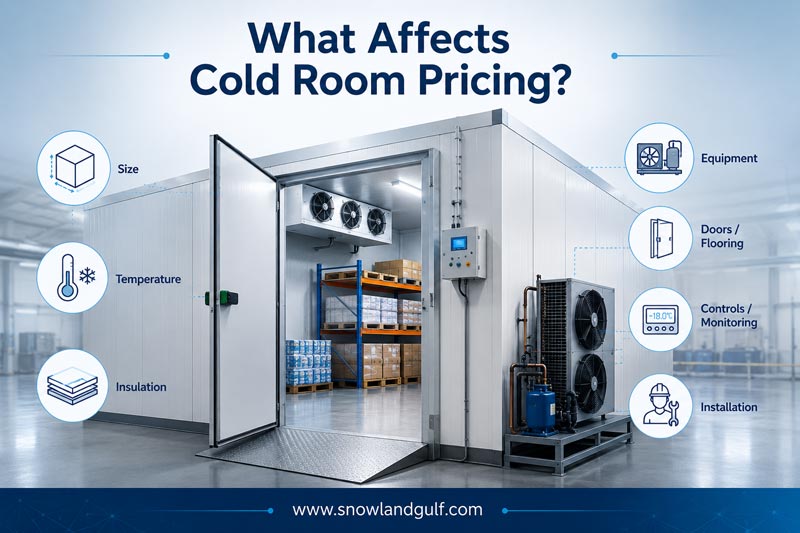
 This is one of the first questions businesses ask when planning a new cold storage facility. However, the answer is not based on room size alone because temperature, insulation, refrigeration capacity, product load, controls, doors, flooring and installation conditions all influence the final cost.
At Snowland, we recommend comparing the complete technical specification rather than choosing a cold room based only on the lowest quotation. Therefore, understanding what factors affect cold room pricing? helps buyers invest in a system that delivers reliable cooling, better energy efficiency and longer operating life.
What Factors Affect Cold Room Pricing?
A cold room UAE project can range from a small restaurant chiller to a large industrial refrigerated warehouse. Although two rooms may have identical dimensions, their prices can differ significantly because the required operating conditions may be completely different.
For example, a room maintaining +5°C for fresh vegetables requires less refrigeration duty than a freezer operating at -20°C. Similarly, a blast freezer designed for rapid product freezing needs much higher refrigeration capacity, stronger airflow and thicker insulation.
Consequently, answering what factors affect cold room pricing? requires looking at the complete application rather than simply calculating the room area.


Does Cold Room Size Affect Pricing?
Yes, room size directly affects panel quantity, flooring, refrigeration load and installation labour. However, overall volume alone cannot determine the final refrigeration capacity.
A 100 cubic metre room used only to store pre-chilled products may need less cooling capacity than a 60 cubic metre room that receives warm products several times every day. Therefore, a professional cold room manufacturer should calculate the actual heat load before selecting equipment.
Additionally, room height can significantly influence the total internal volume. Higher rooms require more panel area and may also need stronger airflow distribution to maintain consistent temperatures.
For large refrigerated warehouses, designers must also consider pallet layouts, forklift movement, loading docks and evaporator positioning. Consequently, warehouse design can influence both construction and refrigeration costs.
How Does Temperature Affect Cold Room Cost?
Required temperature is one of the most important cold room pricing factors. Generally, lower room temperatures require better insulation and more powerful refrigeration equipment.
A standard chiller may operate between approximately +2°C and +8°C, while a freezer commonly operates around -18°C to -22°C. Meanwhile, blast chillers and freezers can operate at much lower temperatures because they must remove product heat quickly.
Therefore, customers asking what factors affect cold room pricing? should always provide the required operating temperature during the quotation stage.
A medical coldroom can also require precise temperature control, monitoring, alarm systems and data logging. As a result, medical applications may cost more than a basic food-storage room of the same dimensions.
Why Does Product Load Matter?
The refrigeration system does more than cool the room air. More importantly, it must remove heat from the products entering the cold room.
For example, storing 2,000 kg of already chilled food requires less capacity than cooling 2,000 kg of food entering at +30°C. Therefore, product entry temperature, daily quantity and required pull-down time have a major impact on refrigeration equipment selection.
Similarly, meat, dairy products, vegetables, frozen food and cooked food have different cooling requirements. Consequently, accurate product information helps the designer select a system that performs correctly without unnecessary oversizing.
This becomes especially important for pre-cooler cold rooms, ripening chambers and blast freezing applications. Therefore, product load remains one of the key answers to what factors affect cold room pricing?
How Important Is Insulation Thickness?
Cold room panels create the thermal barrier between the controlled room temperature and the surrounding environment. Therefore, insulation quality directly influences both cooling performance and operating cost.
A chiller may use a different panel thickness from a freezer or blast freezer. In addition, insulation density, panel joint design, cladding material, fire-rating requirements and surface finish can affect the overall project price.
A modular coldroom typically uses insulated panels that allow fast installation and future modification. However, projects with higher hygiene or corrosion resistance requirements may need stainless-steel finishes, which can increase material costs.
Likewise, freezer flooring usually requires additional insulation compared with many chiller installations. Consequently, panel and floor specification should always be compared carefully when reviewing quotations.
Which Refrigeration Equipment Is Selected?
Refrigeration equipment often represents a significant portion of the cold room investment. The compressor, condenser, evaporator, expansion device, receiver, controls and safety components must all match the calculated load.
Moreover, equipment quality, efficiency and spare-parts availability can influence pricing. A cheaper refrigeration system may reduce the initial purchase price, but poor equipment selection can increase electricity consumption and maintenance costs later.
A professional cold storage manufacturer should clearly identify the major equipment proposed in the quotation. Furthermore, buyers should understand whether the design includes redundancy, standby equipment or additional capacity for future expansion.
Different applications also require different configurations. For instance, a combi coldroom may combine chiller and freezer sections, while a visi coldroom may use glass display doors for retail applications.
Similarly, refrigerated containers, container coldrooms and a skid mounted cold room need compact engineering because refrigeration and controls must fit within limited space.
Do Doors Affect Cold Room Pricing?
Yes. Cold room doors may appear simple, but their design has a major influence on heat gain, accessibility and operational safety.
Hinged doors generally cost differently from sliding doors, while heated freezer-door frames, vision panels, kick plates and automatic closers can add to the price. Furthermore, larger doors require stronger hardware and can increase refrigeration load because more warm air enters during opening.
For retail or display applications, heated glass doors may also be required. Therefore, door size, quantity and operating frequency form part of what factors affect cold room pricing?
Additionally, frequent door opening can increase energy consumption significantly. As a result, PVC strip curtains, air curtains or fast-closing doors may improve performance in busy cold storage facilities.
What About Cold Room Flooring?
Floor construction varies according to application. Some chillers can operate on an existing prepared floor, while freezers may require insulated flooring to reduce heat transfer from below.
Furthermore, food-processing facilities may require hygienic, washable and slip-resistant finishes. Therefore, aluminium chequered plates, resin finishes, stainless-steel surfaces or other protective layers can affect project cost.
Heavy pallet movement also requires stronger floor construction. Consequently, flooring should match both temperature and mechanical load rather than being selected only by price.
How Do Controls and Monitoring Change the Price?
Modern cold storage facilities increasingly use intelligent controls. Although basic temperature controllers may work for simple rooms, many customers now require remote monitoring, alarm notifications, data logging and BMS integration.
For example, a medical coldroom may require continuous temperature records. Similarly, supermarkets, central kitchens and distribution centres may need remote alarms so facility teams can respond quickly if temperatures rise.
IoT monitoring also allows managers to check performance from multiple locations. Therefore, advanced controls can increase the initial project cost while providing better visibility and operational protection.
Moreover, dual refrigeration systems may be required for critical products. Consequently, standby equipment becomes another important consideration when evaluating cold room pricing factors.
Does Installation Location Influence Cost?
Yes. Site location affects transportation, manpower, accommodation, access, crane requirements and commissioning arrangements.
For example, a cold room manufacturer Abu Dhabi project may have different logistical requirements from a cold room supplier Al Ain installation. Likewise, customers searching for the best cold room supplier in Sharjah should compare site execution capability in addition to equipment cost.
Snowland also supports requirements across the wider region. Therefore, customers looking for a cold room manufacturer in GCC, cold room manufacturer in Oman, cold room installation in Bahrain, cold room manufacturer in Saudi Arabia, cold room manufacturer in Qatar or cold room manufacturer in Kuwait should consider transportation, customs, local regulations and site supervision.
International projects may require even more planning. For instance, a customer searching for a cold room supplier in India, cold room supplier in UK or cold room supplier in Africa should review freight, import requirements, local installation support and spare-parts availability.
Does Industrial Refrigeration Cost More?
Larger facilities often need more sophisticated refrigeration systems. Therefore, industrial refrigeration projects can involve multiple compressors, centralised controls, large evaporators, condensers and extensive piping networks.
In some applications, ammonia refrigeration offers an efficient solution for large industrial facilities. However, ammonia systems require experienced engineering, additional safety considerations and proper plant-room design.
Similarly, glycol & water chillers may serve process cooling, food production or indirect cooling systems. Consequently, the refrigeration technology should match the application rather than simply follow the lowest initial cost.
This is why what factors affect cold room pricing? becomes especially important for factories, logistics centres and large food-processing plants.
How Much Does Customisation Affect Cost?
Every project has different operating requirements. Therefore, special dimensions, multiple temperature zones, stainless-steel interiors, glass fronts, special doors and restricted installation spaces can increase engineering and manufacturing work.
A standard modular coldroom usually costs less than a highly customised system with multiple compartments and complex controls. However, customised design may improve workflow and use available space more effectively.
Similarly, ripening chambers need controlled temperature and airflow, while some applications also require humidity management. Consequently, specialised cold rooms must be priced according to their actual process requirements.
Why Do Quotations From Suppliers Differ?
Different quotations often include different scopes of work. Therefore, the lowest quotation does not always provide the lowest total project cost.
One supplier may include refrigeration equipment, insulated panels, doors, piping, cabling, drainage, controls, testing and commissioning. Another quotation may exclude several of these items, which can create additional costs during installation.
Moreover, warranty coverage and after-sales support can differ significantly. Therefore, buyers should compare equipment brands, technical specifications, installation scope, warranty terms and service capability before making a final decision.
When asking what factors affect cold room pricing?, always evaluate total lifecycle value rather than only the purchase price.
How Can You Get an Accurate Cold Room Price?
Provide complete technical information from the beginning. This allows the supplier to calculate the correct refrigeration duty and prepare a realistic quotation.
Ideally, share room dimensions, operating temperature, product type, product entry temperature, daily loading quantity, pull-down requirement, door size, door-opening frequency, electrical supply and project location.
Additionally, explain whether you need monitoring, standby refrigeration or BMS connectivity. Consequently, your cold room manufacturer can design the system around the actual operational requirement.
Why Choose Snowland?
Snowland provides engineered cold storage solutions for commercial and industrial applications. Our scope includes modular cold rooms, chillers, freezers, blast chilling, refrigerated warehouses, containerised systems and industrial refrigeration solutions.
Furthermore, we focus on heat-load calculations, equipment selection, installation quality and after-sales support. Therefore, customers receive a system designed around actual operating conditions rather than a generic equipment package.
For more information, explore Snowland's solutions for cold rooms, blast freezing, industrial refrigeration and cooling systems.
Frequently Asked Questions
Temperature, refrigeration load, room size and product load usually have the greatest impact on overall cost.
Not necessarily. A smaller blast freezer can cost more than a larger storage chiller because it requires much higher refrigeration capacity.
A freezer normally requires stronger insulation and lower-temperature refrigeration equipment. Therefore, its overall system cost usually increases.
Yes. Thicker and higher-quality insulation can increase initial cost, although it can also reduce heat gain and improve efficiency.
Blast freezers generally cost more because they need high refrigeration capacity, strong airflow and fast product pull-down.
Yes. Remote monitoring, alarms, BMS connectivity and data logging add controls and engineering to the system.
Provide dimensions, temperature, product details, daily quantity, entry temperature, pull-down time, site location and electrical supply.
No. Compare insulation, refrigeration equipment, controls, installation scope, warranty and after-sales support before selecting a supplier.
So, what factors affect cold room pricing? The final cost depends on room size, required temperature, product load, insulation, refrigeration equipment, flooring, doors, controls, site conditions and level of customisation.
Therefore, the best approach is to compare complete technical solutions rather than only the final price. Snowland focuses on designing cold rooms that provide reliable temperature control, practical operation and long-term value for customers across the UAE, GCC and international markets.


