
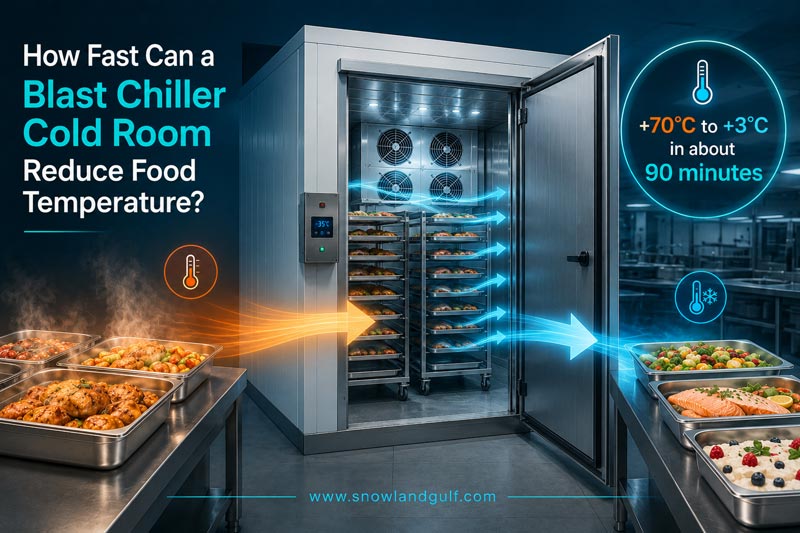
 How fast can a blast chiller reduce food temperature? A properly selected commercial blast chiller can typically reduce hot food from around +70°C to +3°C in approximately 90 minutes, although the actual time depends on product type, thickness, quantity, loading method, airflow and equipment capacity. Snowland specifies this 90-minute cooling benchmark for its blast chilling applications.
Unlike a conventional refrigerator, a blast chiller uses powerful refrigeration and high-velocity cold airflow to remove heat quickly. Therefore, kitchens, bakeries, catering facilities and food-processing plants can cool cooked products rapidly before transferring them into refrigerated storage.
How Quickly Does Blast Chilling Work?
When operators ask how fast can a blast chiller reduce food temperature?, the practical answer is usually around 90 minutes for a typical +70°C to +3°C chilling cycle under suitable operating conditions. However, this figure should never replace actual product-core temperature monitoring.
For comparison, the FDA Food Code cooling requirement for time/temperature control for safety foods calls for cooling from 57°C to 21°C within two hours, followed by cooling to 5°C or below within a total of six hours. Therefore, a correctly applied blast chiller can provide a much faster controlled-cooling process than simply placing hot food in conventional refrigerated storage.


Why Is Fast Cooling Important?
Cooked food retains a large amount of heat. Consequently, leaving it to cool slowly can keep the product within temperature ranges where microorganisms can grow more readily.
Rapid chilling moves food through these temperatures quickly while helping operators preserve product quality. Snowland's blast chilling solutions are designed for applications such as restaurants, hotels, bakeries, central kitchens, catering operations, meat processing, seafood processing and ready-to-eat food production.
Does Faster Cooling Protect Food Quality?
Yes. Rapid cooling can help retain texture, appearance and overall product quality because the food spends less time cooling under uncontrolled conditions.
Moreover, rapid chilling supports better production planning because kitchens can cook in batches, chill products quickly and move them into properly controlled cold storage for later use. Snowland identifies food safety, product quality and efficient food handling as key reasons for using blast chillers.
What Controls Blast Chiller Cooling Speed?
How fast can a blast chiller reduce food temperature? depends on much more than the air temperature displayed on the controller. In fact, the critical measurement is usually the temperature at the product core.
Several factors directly influence cooling performance:
- Starting temperature: A product entering at +90°C needs more heat removal than one entering at +60°C.
- Product thickness: A shallow tray cools faster than a deep container.
- Food type: Soup, rice, meat, bakery products and sauces transfer heat differently.
- Batch quantity: Overloading increases cooling time.
- Tray spacing: Adequate clearance improves airflow around the product.
- Air circulation: Blocked evaporator airflow reduces heat transfer.
- Refrigeration capacity: The compressor, evaporator and condenser must match the required load.
- Door opening: Repeated opening introduces heat and increases cooling time.
- Probe positioning: The sensor should measure the warmest relevant part of the food.
Therefore, equipment selection should always consider both kilograms per batch and required pull-down time, rather than cabinet dimensions alone.
Why Does Product Thickness Matter?
Cold air initially removes heat from the food's surface. Then, heat from the centre must travel toward the colder outer layers.
Consequently, 25 mm to 40 mm food depth may cool far faster than the same product packed into a deep container. Therefore, food-processing teams should use appropriate trays and avoid excessively deep loading wherever the process allows.
Blast Chiller vs Cold Room
A blast chiller and a conventional cold room perform different jobs. A blast chiller rapidly removes product heat, while a cold room primarily maintains already chilled products at their required storage temperature.
Therefore, placing large quantities of hot food directly inside a standard cold room UAE installation can increase the refrigeration load and affect other stored products. Instead, operators should blast chill the food first and then transfer it to the cold storage Dubai facility.
Snowland's cold room guidance similarly separates blast chilling from normal refrigerated holding and storage applications.
How Is a Blast Chiller Selected?
When determining how fast can a blast chiller reduce food temperature?, engineers first need to understand the actual product load. For example, cooling 50 kg of pastry products differs considerably from chilling 500 kg of cooked meat.
Therefore, professional design considers incoming product temperature, required final core temperature, total kilograms per cycle, pull-down time, ambient conditions, tray configuration and daily operating cycles.
For high-volume food processing, the refrigeration arrangement may connect with larger industrial refrigeration, ammonia refrigeration, or glycol & water chillers. Snowland also integrates glycol and water chiller systems into customized cold-storage applications.
Where Are Blast Chillers Used?
Modern blast chillers and freezers support far more than restaurant kitchens. They also serve food factories, bakeries, catering facilities, hotels, seafood plants, meat processors and central production kitchens.
Moreover, rapid chilling can form part of larger refrigeration facilities containing a modular coldroom, combi coldroom, visi coldroom, medical coldroom, refrigerated containers, skid mounted cold room, refrigerated warehouses, pre-cooler cold rooms, ripening chambers or container coldrooms.
Why Does Refrigeration Design Matter?
Businesses searching for a cold room manufacturer, cold storage manufacturer, cold room manufacturer Abu Dhabi, cold room supplier Al Ain, or the best cold room supplier in Sharjah should evaluate engineering capability as well as equipment price.
A properly designed refrigeration solution should match cooling capacity to the real application. Consequently, companies working across multiple markets may also require a cold room manufacturer in GCC, cold room manufacturer in Oman, cold room installation in Bahrain, cold room manufacturer in Saudi Arabia, cold room manufacturer in Qatar, cold room manufacturer in Kuwait, cold room supplier in India, cold room supplier in UK, or cold room supplier in Africa.
How Fast Is Fast Enough?
So, how fast can a blast chiller reduce food temperature? For many commercial applications, a target of approximately +70°C to +3°C within 90 minutes provides a useful benchmark, but engineers must confirm performance against the actual product, batch size and operating conditions.
Most importantly, operators should monitor food core temperature, not simply cabinet-air temperature. Therefore, correct probes, loading practices, airflow and refrigeration capacity all contribute to reliable chilling performance.
Frequently Asked Questions
A commercial blast chiller can typically reduce food from around +70°C to +3°C in about 90 minutes, depending on the product and load.
Many blast chilling systems target approximately +3°C at the food core before refrigerated storage.
Yes. Blast chillers specifically handle rapid cooling of freshly cooked or processed food.
Overloading, deep containers, poor airflow, high starting temperatures or inadequate refrigeration capacity can increase cooling time.
No. A blast chiller rapidly cools food, while a blast freezer continues lowering product temperature for frozen storage.
A standard cold room mainly maintains storage temperature and generally does not provide the same rapid product pull-down capability.
Measure the product core temperature to verify that the food has reached the required chilling target.
Yes. Proper spacing allows high-velocity cold air to circulate around the food and improves heat transfer.
Rapid Cooling With the Right System
Understanding how fast can a blast chiller reduce food temperature? helps food businesses select equipment based on actual production requirements rather than cabinet size alone. A correctly engineered blast chiller can deliver rapid cooling, improve operational control and prepare products efficiently for refrigerated storage.
Snowland provides blast chillers and freezers, cold rooms, cold storage and industrial refrigeration solutions for commercial and industrial applications across the UAE, GCC and international markets. From system design and installation to commissioning and after-sales support, the objective is reliable temperature control matched to each application.
HVAC informed business listings on UAE platforms, enhance transparency and ease of verification for customers.


