
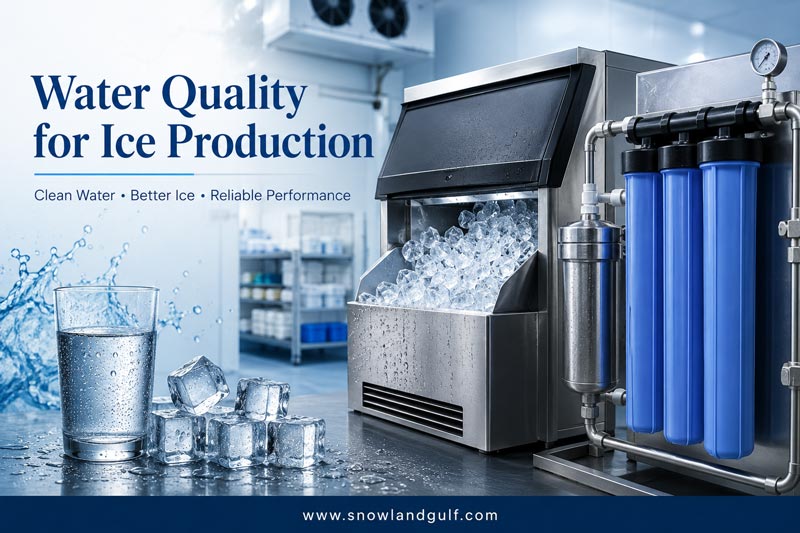
 Ice used for beverages, restaurants, hotels, seafood processing, food factories, supermarkets and industrial applications should always be produced from clean, potable water that meets local drinking-water standards. For operators and facility managers, understanding what water quality is required for ice production? is essential because safe ice depends on more than drinking water alone. Hardness, total dissolved solids, sediment, microorganisms, taste and odour can all influence ice quality as well as equipment performance.
For businesses operating a cold room UAE facility or cold storage Dubai operation, water quality should form part of the overall food-safety and refrigeration strategy. Therefore, regular water testing and suitable treatment can help produce cleaner, safer ice while reducing scale buildup, maintenance requirements and unexpected equipment breakdowns.
What Makes Water Suitable for Ice Production?
Good ice starts with good water. In most commercial applications, the incoming water should be potable, clear, free from harmful microorganisms and suitable for human consumption.
However, even potable water can contain minerals that create operational problems inside an ice machine. For this reason, operators should evaluate the complete water condition before choosing filtration or treatment equipment.
Important water parameters include:
- Microbiological quality
- Water hardness
- Total dissolved solids or TDS
- Sediment and turbidity
- pH level
- Chlorine content
- Taste and odour
- Chemical contamination
- Iron and manganese
- Salinity where applicable
As a result, professional water analysis is one of the best starting points for reliable water quality ice production.


Why Is Microbiological Water Quality Important?
Ice is considered a food product when it is used for human consumption. Therefore, the water entering an ice machine should not contain harmful bacteria, viruses or other microorganisms.
Freezing does not automatically make contaminated water safe. Instead, microorganisms may survive low temperatures and remain present in the finished ice.
Consequently, businesses should maintain safe water sources, hygienic storage tanks and clean water distribution lines. Regular cleaning and sanitising of the ice machine is equally important because contamination can occur after the water enters the equipment.
Can Hard Water Affect Ice Machines?
Yes. Hard water contains higher levels of calcium and magnesium, which can create mineral deposits inside an ice machine.
Over time, scale may form on evaporator surfaces, water circuits, valves, spray nozzles and distribution systems. Therefore, excessive scale can increase maintenance, reduce water flow and affect overall machine efficiency.
A properly selected water softener, scale-control filter or reverse osmosis system may help depending on the incoming water condition. However, treatment should always match the water analysis and equipment manufacturer's recommendations.
Does Hard Water Affect Ice Appearance?
It can. High mineral content may make ice look cloudy or leave visible deposits inside the machine.
However, cloudy ice is not always a sign of poor water quality because trapped air and the freezing method can also influence appearance. Therefore, water testing is more reliable than judging ice quality by appearance alone.
What Is the Role of TDS?
Total dissolved solids, commonly called TDS, represent the amount of dissolved minerals and salts in water. High TDS can contribute to mineral buildup and may influence the taste and appearance of finished ice.
Therefore, commercial ice plants should evaluate TDS together with hardness, alkalinity and other water parameters. Moreover, extremely low mineral content may also require consideration because certain ice machines depend on specific water conductivity levels.
For this reason, there is no single TDS value that suits every ice machine and every project.
Is Water Filtration Necessary?
In many commercial applications, yes. Water filtration helps reduce sediment, particles, undesirable taste and odour before the water enters the ice machine.
Additionally, specialised filters can help control scale or reduce specific contaminants. As a result, filtration can support cleaner ice while protecting internal components.
However, filters should never be selected only according to price. Instead, consider daily ice production, water consumption, filter capacity, incoming pressure and source-water quality.
Is RO Water Good for Ice Production?
Reverse osmosis, or RO, can be useful when incoming water contains high dissolved solids, salinity or contaminants that cannot be controlled effectively through standard filtration. Therefore, RO is commonly considered for locations with difficult water conditions.
However, RO is not automatically required for every ice-making system. In some cases, standard filtration and scale control may be sufficient.
Furthermore, extremely low-mineral water can affect certain equipment, so professional selection remains important.
Does Taste and Odour Matter?
Yes. Ice often goes directly into drinks, food products or seafood displays, which means undesirable taste or smell may transfer to the final application.
Chlorine, organic compounds, storage-tank contamination and old pipework can influence water taste. Therefore, appropriate carbon filtration may be considered where required.
However, businesses should first identify the actual cause instead of simply adding filters without testing.
How Important Is Ice Machine Cleaning?
Very important. Even excellent incoming water cannot produce hygienic ice if the ice machine remains dirty.
Water trays, pumps, distribution tubes, storage bins and other wet components can accumulate scale, slime or biological growth. Therefore, facilities should follow a planned cleaning and sanitising schedule.
Additionally, employees should use clean scoops and avoid touching ice directly with their hands. Proper drainage and clean storage bins further reduce contamination risks.
Water Quality and Cold Chain Design
Ice production often forms part of a wider refrigeration system. For example, seafood processors may use flake ice together with chilled processing areas and cold rooms, while food factories may combine ice production with product cooling and refrigerated storage.
Snowland supports integrated refrigeration projects that can include a modular coldroom, combi coldroom, visi coldroom, medical coldroom, refrigerated containers, skid mounted cold room, refrigerated warehouses, pre-cooler cold rooms, ripening chambers, blast chillers and freezers and container coldrooms.
Therefore, water treatment, ice production and refrigeration should ideally be considered together during project planning.
Why Does Proper Ice Storage Matter?
Producing good ice is only one part of the process. After production, ice should remain protected from contamination and unnecessary melting.
Therefore, the storage area should provide suitable insulation, drainage, hygiene and refrigeration capacity. In larger facilities, the ice storage room may also need mechanical handling or automated delivery systems.
A professional cold room manufacturer or cold storage manufacturer can coordinate the refrigeration system with the ice-production requirement.
Industrial Refrigeration for Large Ice Plants
Large ice plants and food-processing facilities often require more complex refrigeration solutions. Depending on the capacity, the plant may use industrial refrigeration, ammonia refrigeration or glycol & water chillers.
For example, ammonia systems can be suitable for high-capacity industrial applications, while glycol systems may provide controlled secondary cooling for process equipment. Therefore, system selection should depend on load, temperature requirement, safety, efficiency and site conditions.
Snowland designs refrigeration solutions based on actual operating requirements rather than using one standard approach for every project.
Water Quality in GCC Ice-Making Projects
Water conditions can differ significantly across the GCC. Therefore, a project in the UAE may require a different treatment strategy from a project in Oman, Saudi Arabia, Qatar, Kuwait or Bahrain.
Businesses looking for a cold room manufacturer abu dhabi, cold room supplier Al Ain or the best cold room supplier in sharjah should include water-quality evaluation when ice-making equipment forms part of the project.
Snowland also supports projects as a cold room manufacturer in GCC, cold room manufacturer in Oman, cold room installation in bahrain, cold room manufacturer in saudi arabia, cold room manufacturer in qatar and cold room manufacturer in kuwait.
Furthermore, international projects can be supported based on technical requirements for customers searching for a cold room supplier in India, cold room supplier in UK or cold room supplier in Africa.
How Can You Improve Ice Quality?
Start by testing the incoming water. Afterwards, compare the results with the ice-machine manufacturer's water requirements.
Next, choose suitable treatment such as sediment filtration, carbon filtration, scale control, softening or reverse osmosis where required. In addition, maintain a scheduled cleaning and sanitising program.
Finally, monitor the finished ice for taste, odour, appearance and operational consistency.
Frequently Asked Questions
Clean, potable, properly treated water with controlled minerals and safe microbiological quality.
Yes. Hard water can cause scale buildup and reduce machine efficiency over time.
Yes. RO water is suitable when high TDS or mineral content requires treatment.
Yes. Most commercial ice machines benefit from proper filtration and scale control.
No. Freezing does not eliminate all bacteria, so always use potable water.
Cloudy ice can result from minerals, trapped air, and the freezing process.
Yes. High TDS can affect ice clarity, taste, scaling, and equipment performance.
Clean the ice machine regularly according to the manufacturer’s recommended maintenance schedule.
Yes. Snowland provides integrated ice production, cold storage, and refrigeration solutions.
So, what water quality is required for ice production? The best starting point is potable water that meets applicable drinking-water requirements and remains free from harmful microbiological contamination.
However, reliable water quality ice production also depends on controlling hardness, TDS, sediment, taste, odour and scale. Therefore, proper water testing, filtration and equipment maintenance are essential for consistent results.
For complete refrigeration projects, Snowland can integrate ice-making equipment with cold rooms, refrigerated storage, industrial refrigeration and process cooling systems according to the required capacity and operating conditions.


