
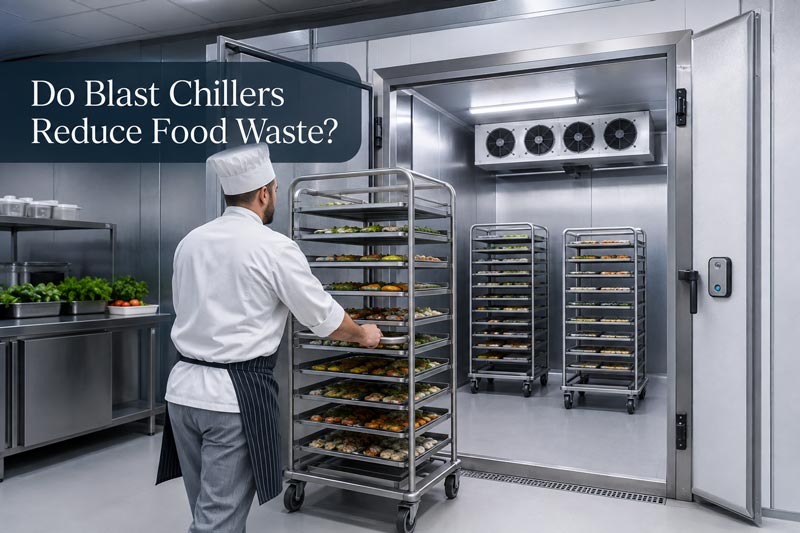
 Properly designed blast chiller cold rooms can help reduce avoidable food losses by cooling cooked or processed food rapidly after production. The question “Do blast chillers reduce food waste?” is especially relevant for commercial kitchens because faster cooling can help preserve food quality, support safer handling and improve control over products that need to move quickly into chilled storage.
This is particularly useful in hotels, central kitchens, catering operations and food-processing facilities where large batches are prepared every day. Walk-in blast chiller cold rooms can accommodate full trolley loads and high-volume production, allowing food to move efficiently from cooking to rapid chilling and then into a separate holding cold room. As a result, businesses can improve production planning, reduce unnecessary disposal and manage chilled inventory more effectively.
Do Blast Chillers Reduce Food Waste in Large Kitchens?
Do blast chillers reduce food waste when production volumes are high? In many applications, yes, because blast chiller cold rooms allow operators to rapidly cool large batches immediately after cooking or processing.
The FDA identifies improper cooling of Time/Temperature Control for Safety foods as an important food-safety concern. Its Food Code cooling guidance calls for cooked TCS food to cool from 57°C to 21°C within two hours and then to 5°C or below during the following four hours. The FDA also specifically identifies rapid cooling equipment as one method that can assist this process.
Therefore, a properly engineered blast chilling room can become an important part of a controlled cook-chill operation.


How Blast Chiller Cold Rooms Work
Unlike a normal cold room, a blast chiller cold room handles a substantial product heat load within a short period. Powerful evaporators move high volumes of low-temperature air around loaded trays, trolleys or racks so heat transfers from the product to the refrigeration system quickly.
After the required core temperature has been achieved, operators normally transfer the chilled food into a separate holding cold room. Consequently, the blast chiller becomes available for the next production batch instead of being occupied as a storage space.
Snowland provides blast chiller and freezer solutions for commercial kitchens, hotels, bakeries, catering facilities and food-processing applications.
Can Faster Cooling Protect Food Quality?
Yes. Rapid temperature reduction can help retain the intended texture, moisture and appearance of suitable food products.
Moreover, when the application requires blast freezing, fast freezing helps produce smaller ice crystals. USDA guidance explains that rapid freezing helps prevent the formation of large ice crystals that can damage food structure and contribute to moisture loss during thawing.
As a result, less product may need to be rejected because of poor texture, excessive drip loss or inconsistent quality.
Food Waste Reduction Starts Before Storage
Do blast chillers reduce food waste simply by making the room colder? No. The real benefit comes from controlling the complete process from cooking to rapid chilling and finally to holding storage.
For example, consider a large hotel preparing several hundred kilograms of cooked food for banquet operations. Instead of leaving excess prepared food to cool slowly, suitable products can enter the blast chiller cold room on stainless-steel trolleys and follow an approved cooling cycle.
Afterwards, the food can move into a dedicated holding chiller. Therefore, the blast chiller cold room remains a processing area rather than becoming an overloaded storage room.
Better Batch Production and Planning
Do blast chillers reduce food waste during batch production? They can, particularly when kitchens combine blast chilling with accurate forecasting, portion control, FIFO or FEFO procedures and reliable temperature monitoring.
For instance, a central kitchen can prepare food during off-peak hours, blast chill suitable batches and release them according to its planned production schedule. Consequently, the operation can reduce unnecessary last-minute production while improving consistency.
Moreover, planned batch processing can make labour and kitchen equipment more productive. However, operators must still follow approved food-handling procedures, storage limits and local regulatory requirements.
Blast Chiller Cold Room vs Normal Cold Room
A conventional storage cold room primarily maintains products that are already chilled. In comparison, a blast chiller cold room must remove a much larger amount of product heat within a controlled pull-down period.
Therefore, the refrigeration load can be substantially higher than the load required for an ordinary modular coldroom.
A blast chilling system may require high-capacity evaporators, suitable air velocity, larger refrigeration equipment, properly positioned trolley spaces and enough clearance for unrestricted airflow. Meanwhile, the holding room requires enough capacity to receive completed batches without disrupting future blast cycles.
This distinction becomes critical when planning cold room uae or cold storage dubai projects.
Is Room Size Enough for Selection?
No. Selecting a blast chiller simply from room dimensions can lead to serious performance problems.
Instead, engineers should determine:
- Product quantity per batch
- Product entry temperature
- Required final core temperature
- Required pull-down time
- Number and size of trolleys
- Tray dimensions and loading density
- Product type and thickness
- Number of cycles per day
- Evaporator airflow
- Door opening frequency
- Ambient conditions
- Holding-storage capacity
Therefore, two blast chiller cold rooms with identical dimensions may require completely different refrigeration capacities.
Why Airflow Matters
Do blast chillers reduce food waste effectively when airflow is restricted? Performance will suffer if trolleys, trays or products block the designed air path.
Cold air must circulate around the loaded products and return to the evaporator efficiently. Therefore, engineers must consider trolley spacing, tray arrangement, evaporator position and the loading direction during design.
In addition, staff need enough space to load and unload trolleys safely without leaving large unused areas inside the room. Consequently, an efficient blast chiller cold room should balance refrigeration capacity with practical material movement.
Blast Chilling and Holding Storage Should Be Separate
One common mistake is trying to use the blast chiller cold room as both a rapid cooling room and a permanent storage room.
However, this approach can reduce daily production capacity. If already chilled products occupy the room when another hot batch arrives, airflow can become restricted and operational planning becomes difficult.
Therefore, high-volume facilities should normally have a separate holding chiller or freezer sized according to daily production and storage requirements.
For example, a facility blast chilling 2,800 kg per cycle may need a much larger holding freezer if several completed batches must remain stored. The blast room itself only needs enough practical space for the required batch, refrigeration equipment, airflow and safe trolley movement.
Applications for Blast Chiller Cold Rooms
Do blast chillers reduce food waste across different food sectors? The principle applies wherever large quantities of suitable cooked or processed products require rapid temperature reduction.
Typical applications include hotels, catering kitchens, central kitchens, airline catering, bakeries, meat processing, poultry processing, seafood facilities, ready-meal production and institutional kitchens.
In addition, a complete cold chain may include combi coldroom, visi coldroom, refrigerated warehouses, pre-cooler cold rooms, ripening chambers, refrigerated containers, container coldrooms and skid mounted cold room solutions.
Other specialised projects may require a medical coldroom, although healthcare temperature-control requirements differ significantly from food blast chilling.
Industrial Refrigeration for Larger Blast Rooms
As batch capacity increases, the refrigeration system becomes more demanding. Therefore, larger blast chiller and freezer facilities may use industrial refrigeration, ammonia refrigeration or glycol & water chillers, depending on project scale and application.
Snowland also provides industrial refrigeration solutions designed for larger refrigeration loads and integration with cold rooms and cold-storage facilities.
Consequently, the best system does not begin with selecting a compressor. It begins by understanding the product load, cycle time and operating sequence.
Can Blast Chilling Improve Inventory Control?
Yes. Blast chilling can support better inventory control because completed batches can move through a clear production sequence.
For example:

Cooking → Trolley Loading → Blast Chilling → Core Temperature Check → Holding Cold Room → Dispatch or Service
Therefore, production teams can label and identify batches more consistently. Moreover, operators can combine this process with digital temperature records and stock-control systems.
Regional Cold Room Engineering
Businesses searching for a cold room manufacturer abu dhabi, cold room supplier Al Ain or best cold room supplier in sharjah should evaluate engineering capability rather than comparing room dimensions and price alone.
Similarly, international customers may require a cold room manufacturer in GCC, cold room manufacturer in Oman, cold room installation in bahrain, cold room manufacturer in saudi arabia, cold room manufacturer in qatar or cold room manufacturer in kuwait.
Furthermore, businesses may work with a cold room supplier in India, cold room supplier in UK or cold room supplier in Africa for regional projects. However, every blast chilling project should still begin with accurate product and heat-load data.
Why Snowland for Blast Chiller Cold Rooms?
Snowland approaches blast chiller cold rooms as an engineered refrigeration process rather than simply an insulated room with refrigeration equipment.
Therefore, the design review can consider product type, batch capacity, incoming product temperature, target core temperature, pull-down time, trolley arrangement, airflow, insulation, loading and unloading requirements and final holding capacity.
Snowland already provides blast chillers, blast freezers, walk-in cold rooms, modular cold rooms and industrial refrigeration solutions for food-service and processing applications.
Moreover, customers can combine rapid chilling with holding cold storage instead of sourcing each part of the process separately.
Do Blast Chillers Reduce Food Waste? Final Answer
Do blast chillers reduce food waste? Yes, particularly when correctly sized blast chiller cold rooms form part of a controlled cook-chill and cold-storage process.
Rapid chilling can support food-safety controls, preserve product quality, improve batch planning and reduce unnecessary product rejection. However, refrigeration equipment alone cannot solve every food-waste issue, so businesses should combine it with good forecasting, hygiene, packaging, labelling and inventory management.
Ultimately, when operators ask do blast chillers reduce food waste?, the better question is whether the entire blast chilling and storage system matches the actual production requirement.
A correctly engineered blast chiller cold room, combined with adequate holding storage, can provide a much more practical solution for high-volume food production.


