
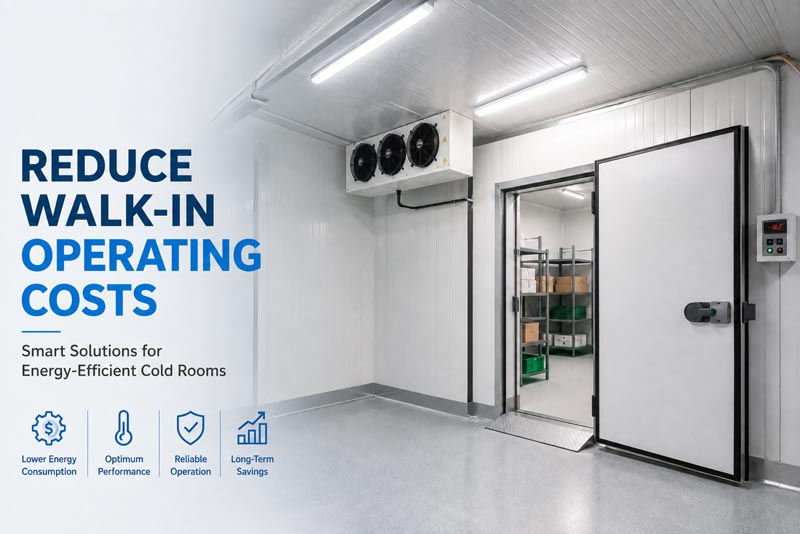
 If you are asking “How do I reduce operating costs of walk-in units?”, the best savings usually come from reducing unnecessary refrigeration load, not simply replacing the compressor. A walk-in chiller or freezer removes heat entering through panels, doors, products, lighting, people and outside air. Therefore, lower operating cost starts with limiting those loads, improving refrigeration efficiency and maintaining the system correctly. For any cold room uae facility or cold storage dubai operation, this matters even more because high ambient temperatures increase refrigeration demand.
To reduce walk-in operating costs, improve insulation and door sealing, minimise door-open time, clean evaporator and condenser coils, optimise defrost, maintain the correct temperature setpoint and monitor compressor run time. In addition, preventive maintenance helps identify small problems before they become expensive faults.
Start With the Insulated Room
A refrigeration system performs efficiently only when the enclosure limits heat gain. Therefore, inspect wall, ceiling and floor panels for damaged joints, gaps, moisture ingress or broken seals.
For a modular coldroom, panel joints and door gaskets need close attention. Likewise, a combi coldroom, visi coldroom or medical coldroom should have properly sealed doors and penetrations.
When reviewing how do I reduce operating costs of walk-in units?, an envelope inspection should come before expensive equipment replacement. After all, installing efficient refrigeration equipment will deliver limited benefits if warm air continuously enters through damaged doors or poorly sealed panels.


Is the Door Wasting Energy?
Every time a cold-room door stays open, warm air enters and conditioned air escapes. Moreover, moisture entering a freezer can freeze on the evaporator and increase defrost demand.
Use self-closing doors where practical and add PVC strip curtains in high-traffic areas. In addition, staff should prepare goods before opening the door instead of keeping it open during sorting or loading.
For larger refrigerated warehouses, rapid doors, loading vestibules or controlled transfer zones can further reduce infiltration. Consequently, reducing door-open time can lower unnecessary refrigeration load without changing the refrigeration plant itself.
Set the Correct Temperature
Many operators run rooms colder than the product actually requires. However, an unnecessarily low setpoint increases refrigeration workload.
Therefore, confirm the correct storage condition for the product. Fresh produce, frozen food and temperature-sensitive medical products all need different operating conditions.
When asking how do I reduce operating costs of walk-in units?, setpoint optimisation is one of the easiest actions because it may require no major hardware change. More importantly, temperature adjustments should always remain within the correct storage requirements of the product.
Clean Coils and Protect Airflow
Dirty condenser coils or restricted airflow make heat rejection harder. Similarly, blocked evaporators reduce heat transfer inside the room.
Therefore, keep cartons and pallets away from evaporator discharge and return-air paths. Also, inspect fan operation and coil cleanliness regularly.
For pre-cooler cold rooms, ripening chambers, and blast chillers and freezers, airflow is especially important because product cooling depends heavily on air movement. As a result, poor airflow can increase pull-down time and overall energy use.
Regular cleaning is relatively simple. Nevertheless, it can make a noticeable difference to system performance when coils operate in dusty or demanding environments.
Can Defrost Be Optimised?
Defrost is necessary in many freezer applications, but excessive defrost wastes energy. On the other hand, insufficient defrost allows ice to build up and reduce evaporator performance.
Therefore, set defrost according to door traffic, humidity, operating temperature and actual frost formation. Where compatible controls are available, demand-based defrost can reduce unnecessary heater operation.
This becomes important when studying how do I reduce operating costs of walk-in units? across several freezer rooms. Even small improvements repeated across multiple evaporators can contribute to lower overall energy consumption.
Match Capacity to the Actual Load
Oversized systems can short-cycle, while undersized systems may run continuously. Consequently, neither condition supports efficient operation.
A professional cold room manufacturer should consider product load, transmission load, infiltration, lighting, people, equipment and required pull-down time. For larger projects, a cold storage manufacturer may also compare individual refrigeration units with rack systems, industrial refrigeration, ammonia refrigeration, or glycol & water chillers.
Likewise, refrigerated containers, container coldrooms and a skid mounted cold room need refrigeration equipment selected for their actual operating environment.
Therefore, correct system sizing remains central to how do I reduce operating costs of walk-in units? Bigger equipment does not automatically mean better performance.
Improve Controls and Monitoring
Modern refrigeration controls can reduce unnecessary compressor, fan and defrost operation. For example, compatible variable-speed condenser fans can respond to actual operating demand instead of running continuously at maximum speed.
In addition, digital temperature controllers, door alarms, energy meters and remote monitoring can identify abnormal run time quickly.
Therefore, when evaluating how do I reduce operating costs of walk-in units?, do not focus only on compressors and evaporators. Better controls can improve everyday operation without requiring replacement of the complete refrigeration system.
Moreover, temperature history and alarm records can help maintenance teams identify gradual changes before they develop into expensive breakdowns.
Reduce Product Heat Load
Warm products create a direct refrigeration load. Therefore, loading high-temperature goods directly into a holding cold room increases compressor run time.
Where rapid cooling is required, dedicated pre-cooler cold rooms or blast chillers and freezers can remove product heat before goods enter holding storage. As a result, the holding cold room performs its intended job instead of acting as a pull-down room.
This separation can be particularly useful for food processing, catering, agriculture, meat processing and other high-throughput cold-chain applications.
Preventive Maintenance Saves Money
Preventive maintenance should cover coil cleaning, drain inspection, fan operation, door-gasket condition, refrigeration performance, electrical connections and control verification.
Moreover, technicians should investigate unusual compressor cycling, rising room temperatures or repeated icing early rather than waiting for complete equipment failure.
Preventive maintenance supports the answer to how do I reduce operating costs of walk-in units? because clean, correctly controlled equipment generally operates more efficiently than neglected equipment.
Additionally, planned maintenance can reduce unexpected downtime, emergency service requirements and product-loss risks.
Regional Design and Supplier Selection
Operating conditions vary considerably by region. Therefore, buyers searching for cold room manufacturer abu dhabi, cold room supplier Al Ain, or best cold room supplier in sharjah should compare engineering capability, equipment selection, service availability and lifecycle cost rather than initial price alone.
Similarly, projects may require a cold room manufacturer in GCC, cold room manufacturer in Oman, cold room installation in bahrain, cold room manufacturer in saudi arabia, cold room manufacturer in qatar, or cold room manufacturer in kuwait.
Meanwhile, international buyers may compare a cold room supplier in India, cold room supplier in UK, or cold room supplier in Africa according to local climate, operating conditions, technical requirements and after-sales support.
Ultimately, the cheapest refrigeration system to purchase is not always the cheapest system to operate.
Why Snowland is helpful?
Snowland focuses on the complete refrigeration requirement rather than looking only at cold-room dimensions. Therefore, factors such as operating temperature, product load, door usage, airflow, ambient conditions, controls and future capacity can form part of the system evaluation.
Solutions can range from walk-in chillers and freezers to modular coldrooms, refrigerated warehouses, blast systems and larger industrial refrigeration applications.
More importantly, how do I reduce operating costs of walk-in units? can be addressed during the design and selection stage instead of waiting until electricity consumption becomes a concern.
For existing facilities, operators can also review current system performance and identify practical opportunities for improving airflow, controls, maintenance practices or operating procedures.
Practical Walk-In Cost Checklist
First, inspect doors, gaskets and panel joints. Next, clean condenser and evaporator coils, verify temperature setpoints and review defrost timing.
Then, check airflow, fan operation, compressor cycling and product-loading practices. Furthermore, make sure staff understand the importance of reducing unnecessary door-open time.
Finally, compare energy consumption and temperature trends over time. Consequently, you can determine whether increasing operating cost comes from equipment condition, maintenance, operational behaviour or increased refrigeration load.
This practical review gives a clearer answer to how do I reduce operating costs of walk-in units?
Frequently Asked Questions
Reduce heat gain, control door openings, maintain coils, optimise defrost and use the correct temperature setpoint.
Yes. They help limit warm-air infiltration when cold-room doors open frequently.
Yes. Poor heat rejection can increase compressor workload and reduce refrigeration efficiency.
Yes. Regular maintenance supports efficient airflow, heat transfer and reliable equipment operation.
Not automatically. Always use the correct product-specific storage temperature rather than an unnecessarily low setting.
Yes. Monitoring can identify abnormal temperatures, long equipment run times and door events earlier.
Not always. First assess equipment condition, efficiency, refrigeration load, maintenance history and upgrade payback.
If you are still asking how do I reduce operating costs of walk-in units?, begin with heat gain, door control, temperature setpoints, airflow, defrost and preventive maintenance. Then, review refrigeration capacity and controls before investing in major replacement equipment.
A properly designed and maintained walk-in system does more than keep products cold. It can also reduce unnecessary energy use, improve temperature stability and support more predictable operating costs.
Whether you require a new walk-in cold room, refrigeration retrofit, energy-efficiency review, refrigerated warehouse or industrial refrigeration system, Snowland can evaluate the application according to its actual operating requirements.
Want to reduce the operating cost of your walk-in cold room?
Contact Snowland to discuss your refrigeration load, existing equipment and operating conditions. Visit www.snowlandgulf.com for cold-room solutions, industrial refrigeration systems and technical refrigeration support.
Stay connected with Snowland. Follow Snowland's official LinkedIn, Facebook, Instagram and other social media channels for cold-room engineering insights, refrigeration project updates, energy-saving tips and cold-chain knowledge.


