
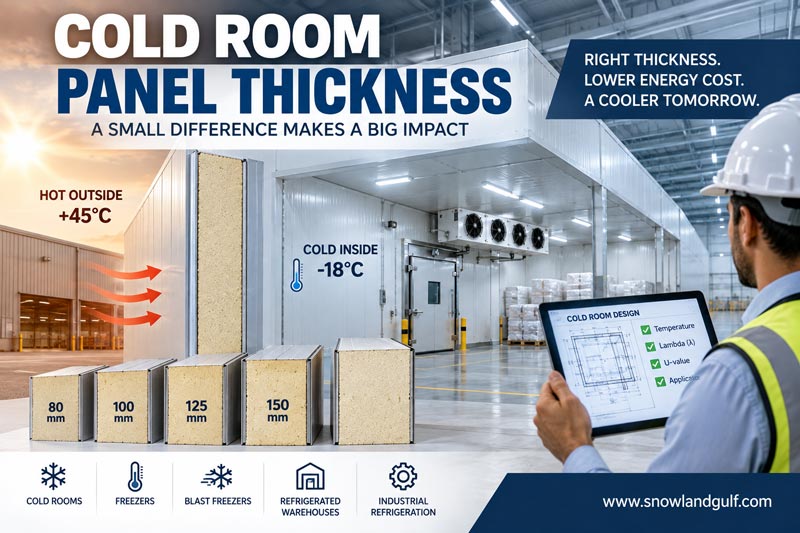
 Selecting the correct Cold Room Panel Thickness is one of the most important decisions in cold-room engineering. Panel thickness affects heat transmission, refrigeration load, condensation control, temperature stability and long-term energy consumption. Therefore, engineers should not select insulation simply because the same panel thickness worked on another project.
A +5°C chiller inside an air-conditioned building operates under completely different conditions from a -25°C freezer installed inside a hot warehouse. Likewise, a blast freezer working at -35°C requires considerably stronger thermal protection than a vegetable chiller.
Consequently, learning How to Select Cold Room Panel Thickness requires an understanding of temperature difference, insulation properties, ambient conditions, panel construction, vapour control, joints and refrigeration heat load.
What Is a Cold Room Insulated Panel?
A cold-room panel is a factory-manufactured sandwich panel that creates the insulated envelope around a refrigerated space.
A typical panel consists of:
Internal metal facing + PUR/PIR insulation core + external metal facing
The insulation core reduces heat transfer between the surrounding environment and the refrigerated space. However, the complete panel system also depends on the metal skin, joint design, vapour sealing, foam quality and installation workmanship.
For example, Snowland and ColdTech projects may use rigid PUR or PIR insulation with densities around 42 to 44 kg/m³, depending on the approved specification.
Therefore, Cold Room Panel Thickness should never be evaluated separately from the complete panel construction.


Why Does Panel Thickness Matter?
Heat always tries to move from a warmer area toward a colder area.
Consider a freezer with:
Outside ambient: +45°C
Room temperature: -20°C
The temperature difference becomes:
ΔT = 65 K
This large temperature difference creates continuous heat flow through the walls, ceiling and floor.
Therefore, a cold room UAE project needs careful insulation selection because high Gulf ambient temperatures can increase transmission heat gain considerably.
Likewise, cold storage Dubai installations located inside hot industrial warehouses may experience high roof temperatures, humidity and continuous door traffic.
As a result, correct Cold Room Panel Thickness reduces unnecessary heat gain and allows the refrigeration plant to operate more efficiently.
Understanding Heat Transfer Through Cold Room Panels
Engineers can estimate panel transmission load using the basic formula:
Q = U × A × ΔT
Where:
Q = Heat transfer in watts
U = Overall heat-transfer coefficient in W/m²K
A = Surface area in m²
ΔT = Temperature difference between inside and outside
The lower the U-value, the better the insulation performance.
For example, consider a 100 m² wall:
Ambient temperature = +40°C
Room temperature = -20°C
Temperature difference = 60 K
U-value = 0.22 W/m²K
Therefore:
Q = 0.22 × 100 × 60
Q = 1,320 W
If thicker insulation reduces the U-value, transmission heat gain will also fall.
Consequently, Cold Room Panel Thickness directly affects one part of the refrigeration heat load.
What Is Thermal Conductivity?
Thermal conductivity indicates how easily heat passes through insulation.
Engineers usually represent it by λ, pronounced lambda.
Lower thermal conductivity means better insulation.
Depending on formulation and certification, rigid PUR and PIR insulation may have thermal conductivity values around:
0.020 to 0.026 W/mK
However, engineers should always use the declared thermal conductivity from the approved panel manufacturer.
Foam chemistry, temperature, blowing agent, aging and manufacturing quality can all affect thermal performance.
Therefore, thickness alone does not tell the complete story.
PUR vs PIR Cold Room Panels
Both PUR and PIR insulation systems are widely used for refrigerated applications.
PUR Insulation
Polyurethane insulation offers very good thermal performance and has been widely used in commercial and industrial cold-room construction.
Typical applications include chillers, freezers, modular rooms, food-storage rooms and temperature-controlled facilities.
PIR Insulation
Polyisocyanurate insulation also provides excellent thermal insulation.
In addition, properly tested PIR systems generally offer improved fire performance compared with standard PUR formulations.
However, engineers should not approve a panel based only on whether the quotation says PUR or PIR.
Instead, the technical comparison should consider insulation density, declared lambda value, fire classification, panel thickness, metal facing, coating system and joint construction.
Does Foam Density Matter?
Yes. However, density and thermal conductivity describe different properties.
Typical rigid PUR or PIR panels for cold-room applications may use densities around 40 to 45 kg/m³.
Snowland project specifications may use approximately 42 to 44 kg/m³, depending on project requirements.
Correct density helps provide:
- Dimensional stability
- Panel rigidity
- Bonding strength
- Resistance to deformation
- Structural integrity
However, higher density does not automatically mean better thermal insulation.
Therefore, engineers should check both density and thermal conductivity before approving a panel.
How to Select Cold Room Panel Thickness by Temperature
The following values provide useful training starting points. However, they should not replace project-specific engineering calculations.
| Application | Typical Temperature | Typical Training Range |
| Ripening chamber | +12°C to +18°C | 60 to 80 mm |
| General chiller | +2°C to +10°C | 80 to 100 mm |
| Medical coldroom | +2°C to +8°C | 80 to 100 mm |
| Pre-cooler | 0°C to +5°C | 80 to 100 mm |
| Freezer | -18°C to -25°C | 100 to 125 mm |
| Low-temperature freezer | -25°C to -30°C | 125 to 150 mm |
| Blast chiller | Application dependent | 100 to 150 mm |
| Blast freezer | -30°C to -40°C or below | Around 150 mm or engineered selection |
| Refrigerated warehouse | Application dependent | 100 to 150 mm |
| Container coldrooms | Application dependent | 80 to 150 mm |
The final Cold Room Panel Thickness depends on operating temperature, ambient conditions, panel performance and energy objectives.
Is 100 mm Enough for a Chiller?
In many commercial applications, yes.
For a room operating between +2°C and +5°C, an 80 mm or 100 mm PUR/PIR panel often provides a practical starting point.
However, engineers should also consider ambient temperature, whether the room sits indoors or outdoors, solar exposure, room dimensions, humidity and operating hours.
Therefore, a cold room manufacturer abu dhabi should not simply specify "100 mm chiller panel" without first understanding the installation environment.
The same engineering principle applies to a cold room supplier Al Ain and the best cold room supplier in sharjah.
Freezer Panel Selection
A freezer usually requires greater insulation thickness because its temperature difference is much larger than that of a chiller.
For rooms around -18°C to -25°C, common starting points include:
100 mm, 125 mm and sometimes 150 mm
For many standard commercial freezers, 100 to 125 mm provides a practical range.
However, a freezer operating inside a hot Gulf warehouse may justify thicker insulation.
Therefore, engineers should evaluate both initial panel cost and long-term operating cost.
Why Does a Blast Freezer Need Thicker Panels?
Blast freezers operate at significantly lower temperatures.
Room air temperatures may reach:
-30°C, -35°C, -40°C or lower
As a result, the temperature difference between the room and surrounding environment becomes very large.
Blast freezing also requires high refrigeration capacity because the system must remove product heat within a short pull-down period.
Therefore, 150 mm panels often provide a practical starting point for blast-freezer applications.
However, final Cold Room Panel Thickness should still follow thermal calculations, design temperature, pull-down time and product load.
Panel Cladding and Material Specification
The insulation core is only one part of the cold-room panel.
Metal cladding protects the insulation and provides durability, hygiene and structural strength.
Snowland can use different cladding materials depending on the approved project specification, including:
FM Approved pre-painted galvanized steel options, PVC-coated galvanized steel, stainless steel, stucco-embossed aluminium and pre-painted aluminium.
Therefore, designers should select the facing according to hygiene requirements, corrosion exposure, wash-down conditions and project specifications.
How Is Coated Steel Constructed?
A typical high-quality coated-steel facing can include several protective layers.
From the exposed surface inward, the construction may include:
P.E. protective layer
- Top coating: Polyester, Plastisol, PET, Microban or PVDF
- Primer
- Zinc coating
- Steel substrate
- Zinc coating
- Epoxy backcoat
Each layer performs a different function.
For example, zinc protects the steel against corrosion. Meanwhile, the top coating provides the required surface finish and resistance to the surrounding environment.
Therefore, engineers should specify the complete facing system rather than writing only "PPGI sheet."
FM Approved Panel Options
Certain projects require materials or panel systems with recognized property-protection approvals.
Where required by the consultant, insurer or project specification, FM Approved panel systems or FM Approved facing options should be selected in accordance with the relevant approval listing.
FM approval should not simply be treated as a logo requirement.
Instead, the engineer should confirm that the exact panel system, materials and application match the applicable project requirements.
This becomes particularly important for large refrigerated warehouses, distribution centres, food factories and high-value industrial facilities.
Panel Edge and Bonding Design
Panel geometry also affects performance.
We can use a U-shaped edge design that helps create strong adhesion between the facing and polyurethane insulation.
In addition, shallow ribbing on the metal surface improves panel rigidity and dimensional stability.
Good bonding between steel and foam helps the panel behave as one composite element.
Therefore, panel design should consider both thermal performance and mechanical strength.
What About Panel Joint Design?
Even a very thick panel can perform badly if warm air leaks through the joints.
Cold-room panels commonly use tongue-and-groove profiles combined with cam-lock mechanisms.
A properly installed joint helps:
- Align adjacent panels
- Compress sealing surfaces
- Reduce air infiltration
- Limit moisture entry
- Maintain thermal continuity
- Improve structural stability
Sealant should also follow the manufacturer's installation procedure.
Therefore, Cold Room Panel Thickness and joint quality must work together.
A properly installed 100 mm panel can perform better than a badly sealed 150 mm panel.
Thermal Bridging in Cold Rooms
Thermal bridging occurs when a conductive material creates an easier path for heat to bypass the insulation.
Common examples include steel supports, fasteners, door frames, floor connections, ceiling supports and poorly insulated service penetrations.
Thermal bridges can cause the external surface temperature to fall.
Consequently, condensation may appear on the outside of the room.
In low-temperature applications, severe thermal bridging can also cause frost or ice formation.
Therefore, engineers must eliminate unnecessary conductive paths wherever possible.
Why Is Vapour Sealing Critical?
Warm air contains moisture.
When warm humid air reaches a freezer envelope, moisture can condense.
If that moisture enters the insulation system, it may eventually freeze.
Therefore, freezer construction needs continuous vapour control around walls, floors, ceilings, corners, doors and penetrations.
The design should prevent warm, humid air from entering the insulation layer.
This principle becomes especially important in Gulf climates where both temperature and humidity can remain high.
Cold Room Floor Panels
Floor insulation requires separate attention because the floor receives thermal and mechanical loads.
A typical cold-room floor can include an insulated panel, vapour protection, load-distributing layer and suitable finished surface.
Depending on the project, Snowland floor systems may use marine plywood, aluminium chequered plate, polyurea or other industrial finishes.
Snowland floor panels can also be designed to support uniform loads up to approximately 2.5 tonnes/m², subject to the approved construction and application.
Therefore, the designer should consider pallet loads, trolleys, racks, equipment and operational traffic before approving the floor.
Do Freezer Floors Need Heating?
Not every freezer requires the same solution.
Large low-temperature freezer buildings can create a risk of subfloor freezing and frost heave.
Therefore, engineers may need to consider antifrost systems such as electrical heating, glycol circuits or underfloor ventilation.
However, the need depends on slab construction, operating temperature, ground conditions and project location.
Consequently, engineers should evaluate the floor as part of the overall thermal design.
Metal Skin Thickness and Finish
Panel skin thickness affects durability and resistance to impact.
Depending on project requirements, a typical specification may use:
Internal skin: approximately 0.7 mm PVC plastisol coated steel
External skin: approximately 0.5 mm pre-painted galvanized steel
Stainless steel can be selected for food-processing areas, high-hygiene applications or aggressive wash-down environments.
Therefore, a complete panel specification should clearly define insulation type, insulation density, panel thickness, internal facing, external facing, coating, joint system and required approvals.
How Do Doors Affect Thermal Performance?
Cold-room doors form part of the insulated envelope.
Therefore, designers should check door insulation thickness, gasket compression, frame construction and threshold detailing.
Freezer doors may also require:
- Frame or gasket heaters
- Pressure relief
- Safety release
- Appropriate threshold treatment
Pressure relief becomes important because temperature changes can create pressure differences between the room and surrounding space.
Therefore, a well-insulated wall cannot compensate for a badly designed door.
Condensation and Dew Point
Condensation forms when a surface temperature falls below the dew-point temperature of surrounding air.
For example, humid warehouse air may contact a cold steel section around an inadequately insulated door frame.
Once the surface drops below dew point, water starts forming.
Therefore, condensation does not always mean that the refrigeration system is operating incorrectly.
Engineers should check air leakage, thermal bridges, panel joints, damaged insulation, humidity and vapour sealing.
How Does Panel Thickness Affect Refrigeration Capacity?
Thicker insulation reduces the transmission portion of refrigeration load.
However, the total heat load normally includes:
Transmission load + product load + infiltration load + people load + lighting load + evaporator fan load + equipment load
Therefore, changing from 100 mm to 150 mm panels does not automatically mean that compressor capacity will fall dramatically.
For example, a busy loading freezer may receive more heat from open doors and incoming products than through its insulated walls.
Consequently, correct Cold Room Panel Thickness should form part of a complete heat-load calculation.
Different Cold Rooms Need Different Designs
A modular coldroom requires strong joints and flexibility.
A combi coldroom may contain chiller and freezer sections inside one installation. Therefore, partition junctions require careful thermal detailing.
A visi coldroom uses large glazed doors or windows, which increase heat gain compared with solid insulated panels.
A medical coldroom places high importance on temperature stability, hygiene and monitoring.
Likewise, pre-cooler cold rooms often receive warm products and therefore experience high product loads.
Ripening chambers may require accurate temperature, humidity and gas management.
Meanwhile, blast chillers and freezers demand high refrigeration capacity and strong low-temperature insulation.
Large refrigerated warehouses can use centralized industrial refrigeration systems.
These systems may include ammonia refrigeration, CO₂ or other refrigerants based on project requirements.
Similarly, glycol & water chillers may provide secondary cooling for process refrigeration applications.
Finally, refrigerated containers, skid mounted cold room systems and container coldrooms need compact but thermally efficient construction.
Therefore, no single Cold Room Panel Thickness suits every application.
Does Project Location Affect Panel Selection?
Yes.
A cold room manufacturer in GCC must consider high ambient temperatures, strong solar gain and humidity.
Likewise, a cold room manufacturer in Oman, cold room installation in bahrain, cold room manufacturer in saudi arabia, cold room manufacturer in qatar and cold room manufacturer in kuwait should evaluate actual local design conditions.
The same principle applies internationally.
A cold room supplier in India may deal with hot and humid climates.
A cold room supplier in UK may face lower ambient temperatures but different regulatory and building requirements.
Similarly, a cold room supplier in Africa may need to consider high ambient conditions, remote locations or electrical reliability.
Therefore, every cold room manufacturer and cold storage manufacturer should base the design on the actual project location.
Technical Checklist Before Panel Approval
Before approving cold-room panels, engineers should verify:
- Design room temperature
- Maximum ambient temperature
- Panel thickness
- PUR or PIR insulation
- Foam density
- Declared thermal conductivity
- U-value
- Fire classification
- FM approval requirements where applicable
- Internal and external metal facing
- Coating system
- Panel joint profile
- Cam-lock arrangement
- Vapour sealing
- Door interface
- Floor loading
- Ceiling loading and suspension
- Service penetrations
- Thermal bridges
- Refrigeration heat-load calculation
This approach turns Cold Room Panel Thickness selection into an engineering decision instead of a guess.
Why Snowland?
Snowland approaches the cold room as one complete refrigeration system.
m
Rather than treating the insulated panel, door and refrigeration equipment as separate products, Snowland considers how each component affects overall performance.
The engineering team evaluates application, storage temperature, ambient conditions, panel construction, refrigeration load, controls, installation and commissioning.
Snowland solutions cover modular coldroom, combi rooms, medical cold rooms, visi cold rooms, pre-coolers, chillers, freezers, ripening rooms, blast chillers, blast freezers, refrigerated warehouses and containerized systems.
Furthermore, Snowland supports larger industrial applications involving industrial refrigeration, ammonia refrigeration and secondary cooling systems.
Through manufacturing capabilities, projects can also access different panel thicknesses, coatings, cladding options and floor constructions according to the approved specification.
Therefore, customers receive coordinated engineering support from a cold room manufacturer rather than selecting insulation and refrigeration equipment independently.
Frequently Asked Questions
For many +2°C to +10°C rooms, 80 to 100 mm PUR or PIR panels provide a practical starting point. However, final selection should consider ambient temperature, U-value and panel thermal data.
A typical starting range is 100 to 125 mm. High ambient temperatures or demanding energy targets may justify thicker insulation.
No. However, 150 mm is commonly considered for low-temperature blast-freezing applications. The engineer should verify the requirement through heat-load calculations.
Both provide effective thermal insulation. PIR generally offers improved fire characteristics, while final selection should consider certified thermal performance, fire classification and project requirements.
Rigid PUR and PIR cold-room panels commonly use densities around 40 to 45 kg/m³. Some Snowland project specifications use approximately 42 to 44 kg/m³.
It can reduce transmission heat load. However, product load, infiltration, door openings, lighting and evaporator fans also determine refrigeration capacity.
Typical causes include air leakage, thermal bridges, poor joint sealing, damaged insulation, high humidity and inadequate vapour control.
FM approval relates to tested property-protection standards for specific products or systems. When a project requires FM Approved materials, engineers should confirm that the exact proposed panel system matches the applicable approval listing.
Yes, if the system is designed for them. For example, Snowland floor-panel constructions can support uniform loads up to approximately 2.5 tonnes/m² depending on the approved design.
Getting Cold Room Panel Selection Right
Understanding How to Select Cold Room Panel Thickness requires much more than choosing between 80 mm, 100 mm, 125 mm or 150 mm.
Engineers must consider room temperature, ambient temperature, thermal conductivity, U-value, foam density, panel cladding, coating system, fire requirements, FM approval where specified, joints, vapour sealing, thermal bridges, doors, flooring and refrigeration heat load.
Furthermore, installation quality matters just as much as material selection.
A correctly selected panel reduces unnecessary heat gain, supports stable room temperature and helps the refrigeration plant operate efficiently.
Most importantly, the cold-room envelope and refrigeration system should always be engineered as one complete system.
Need Technical Support for Your Cold Room?
Planning a chiller, freezer, medical coldroom, blast freezer, pre-cooler, refrigerated warehouse or industrial refrigeration project?
Contact Snowland for technical support in cold-room design, panel selection, refrigeration engineering, manufacturing, installation and commissioning.
Follow Snowland on LinkedIn, Facebook, Instagram, Youtube, Pinterest, X and other social media platforms for cold-room engineering training, refrigeration knowledge, technical updates and project insights.


