Is the Defrost Cycle Correct?
A freezer evaporator naturally develops some frost during operation. Therefore, the system needs correctly designed defrost cycles to remove it before airflow becomes restricted.
Low-temperature applications commonly use electric defrost or hot-gas defrost because simple off-cycle defrost generally cannot provide enough heat at freezer temperatures.
However, more defrost is not always better. Excessive defrost wastes energy and introduces unnecessary heat, while insufficient defrost leaves ice on the evaporator.
What should you check?
Technicians should verify the defrost frequency, heater operation, defrost termination sensor, maximum defrost duration and fan-delay settings. Moreover, they should confirm that refrigeration stops correctly during the defrost sequence.
Snowland freezer-room designs incorporate appropriate defrost strategies according to operating temperature and application requirements.
Why Is Evaporator Airflow Important?
Poor airflow is another major answer to how do I prevent ice buildup in walk-in freezers?
Do not load cartons or products directly against the evaporator. Likewise, never stack products so high that they obstruct supply or return airflow.
When airflow drops, the evaporator cannot exchange heat efficiently. Consequently, coil temperature can become uneven, frost develops faster and the refrigeration system may run longer.
Furthermore, thick ice itself blocks airflow. Therefore, a small icing problem can gradually become a major refrigeration problem. Danfoss notes that blocked evaporator airflow can reduce cooling performance even while the refrigeration circuit continues operating.
Is the Defrost Drain Free From Ice?
During defrost, melted ice must leave the evaporator drain pan quickly. However, if the drain pipe becomes blocked or the drain heater fails, water can freeze again.
Therefore, technicians should inspect:
- Drain pan condition
- Drain slope
- Drain-line heater
- Trap arrangement
- Drain outlet
- Ice around the drain connection
In addition, never allow standing water inside a freezer. Once it refreezes, it may create slippery floors, drainage blockage and heavy ice around the evaporator.
Does Product Loading Matter?
Yes. Warm or wet products add significant moisture and heat to the freezer.
For example, loading uncovered products, wet cartons or products directly from a humid processing area can increase frost formation considerably. Therefore, control product entry temperature and packaging wherever possible.
Furthermore, maintain enough clearance between products, walls and evaporators. Correct loading allows cold air to circulate throughout the room instead of short-cycling directly back into the evaporator.
Can Refrigeration Faults Cause Icing?
Yes. If ice keeps returning even after checking doors and defrost, a refrigeration technician should inspect the system.
Possible causes include:
- Incorrect refrigerant charge
- TXV or EEV problems
- Abnormally low suction pressure
- Incorrect superheat
- Evaporator fan failure
- Faulty temperature sensors
- Incorrect controller parameters
- Refrigerant restrictions
Therefore, how do I prevent ice buildup in walk-in freezers? sometimes requires refrigeration diagnosis rather than simply increasing defrost time.
How Often Should the Freezer Be Checked?
Preventive maintenance works better than emergency ice removal.
Daily, operators should check room temperature, door condition and unusual frost. Meanwhile, maintenance teams should periodically inspect the evaporator, condenser, fans, controls, drain system, defrost heaters and electrical components.
Regular inspection also helps identify gasket deterioration or unusual compressor operation before the freezer develops heavy ice. Snowland provides additional guidance on preventive cold-room maintenance.
Does Freezer Design Reduce Ice Formation?
Absolutely. Correct prevention starts during engineering and installation.
A professional cold room manufacturer or cold storage manufacturer should consider insulation thickness, vapour barriers, door traffic, product load, air distribution, evaporator selection and defrost requirements during design.
Therefore, whether you require a modular coldroom, combi coldroom, visi coldroom, medical coldroom, refrigerated containers, skid mounted cold room, refrigerated warehouses, pre-cooler cold rooms, ripening chambers, blast chillers and freezers or container coldrooms, moisture management should form part of the original engineering strategy.
Snowland's modular systems use insulated panels and engineered refrigeration solutions for different commercial and industrial applications.
What About Large Industrial Systems?
Large facilities may require industrial refrigeration, ammonia refrigeration, or glycol & water chillers instead of conventional standalone systems.
However, the same principle applies. Control moisture, maintain airflow, optimise defrost and prevent uncontrolled air infiltration.
Snowland provides glycol and water chiller solutions for cold storage and industrial refrigeration applications.
How Do I Prevent Ice Buildup in Walk-In Freezers?
To prevent ice buildup in walk-in freezers, keep doors properly sealed, minimise door-opening time, maintain correct defrost cycles, keep products away from evaporator airflow paths and ensure drains work correctly. Additionally, inspect heaters, fans, sensors, expansion valves and refrigeration settings through scheduled preventive maintenance.
If ice returns quickly after removal, investigate the root cause. Simply melting the ice will not solve an air infiltration, drainage, airflow or refrigeration fault.
Why Choose Snowland?
Snowland provides engineered refrigeration solutions across the UAE and international markets. Businesses searching for a cold room manufacturer Abu Dhabi, cold room supplier Al Ain, best cold room supplier in Sharjah, or dependable refrigeration support across Dubai and the wider UAE can benefit from application-specific system design and professional installation.
Moreover, Snowland supports requirements as a cold room manufacturer in GCC, cold room manufacturer in Oman, provider of cold room installation in Bahrain, cold room manufacturer in Saudi Arabia, cold room manufacturer in Qatar, cold room manufacturer in Kuwait, cold room supplier in India, cold room supplier in UK and cold room supplier in Africa.
From compact walk-in freezers to complete refrigerated warehouses, Snowland focuses on reliable temperature control, effective airflow, correct insulation and long-term refrigeration performance.

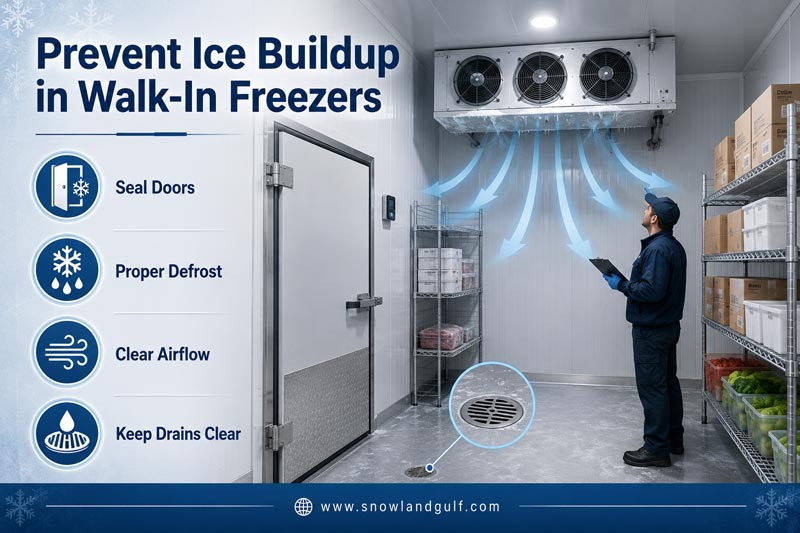 Start by controlling warm-air infiltration, maintaining correct defrost cycles, keeping evaporator airflow clear, checking door seals and ensuring defrost water drains completely. Ice is not simply a cleaning problem. Instead, recurring frost often indicates an operational, airflow, drainage, control or refrigeration issue that requires attention.


