
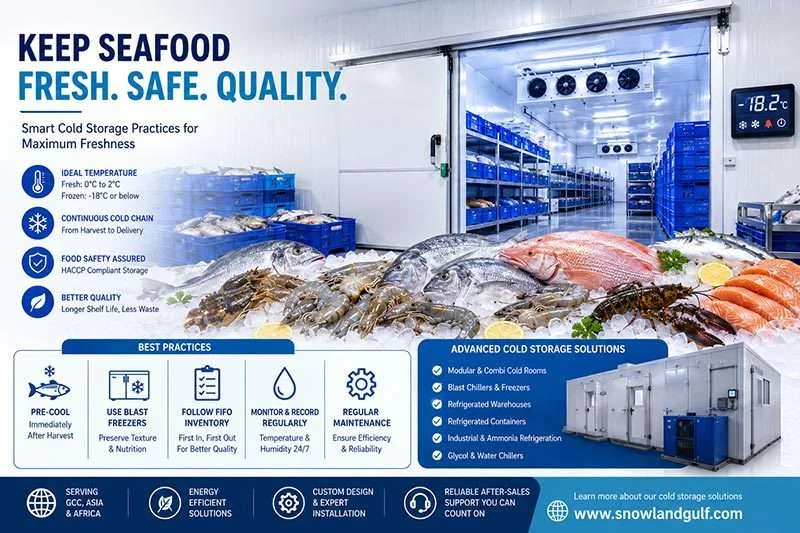
 Seafood is one of the most delicate food products in the global supply chain. From the moment fish, shrimp, crab, lobster, and shellfish are harvested, every minute matters. Without proper temperature control, seafood rapidly loses freshness, nutritional value, texture, and market quality. Therefore, businesses across the Gulf, Asia, and Africa continue investing in advanced seafood cold storage practices that maintain product quality from harvest to consumption.
The seafood industry serves millions of consumers every day. Whether products are supplied to supermarkets, hotels, restaurants, seafood processing plants, exporters, or distributors, maintaining an uninterrupted cold chain has become essential. Consequently, companies increasingly rely on modern cold room UAE solutions, energy-efficient refrigeration systems, and intelligent monitoring technologies to reduce spoilage and comply with international food safety standards.
Large-scale cold storage facilities
Growing seafood exports throughout the UAE, Saudi Arabia, Oman, Qatar, Kuwait, India, and African nations have further increased the demand for reliable cold storage Dubai facilities and customized industrial refrigeration systems. As businesses expand globally, they require dependable cold room manufacturers capable of designing storage facilities that deliver consistent temperatures under demanding environmental conditions.
Snowland has earned a strong reputation by delivering innovative cold storage solutions that help seafood businesses preserve freshness while reducing operational costs. With decades of experience in commercial and industrial refrigeration, Snowland supports customers across the GCC, Asia, Africa, the UK, and India with customized cold room solutions engineered for long-term performance.


Why Is Seafood Cold Storage So Important?
Seafood naturally contains high moisture levels and delicate proteins that begin deteriorating immediately after harvesting. Even small temperature fluctuations encourage bacterial growth, accelerate enzyme activity, and reduce shelf life.
Proper seafood cold storage delivers several important benefits.
- Maintains freshness for longer periods
- Preserves taste, texture, and nutritional value
- Reduces bacterial contamination risks
- Minimizes product losses and financial waste
- Supports HACCP and food safety compliance
- Improves export quality
- Extends product shelf life during transportation
- Increases customer satisfaction
Therefore, seafood businesses cannot depend on conventional refrigeration alone. Instead, they require professionally engineered cold rooms designed specifically for seafood storage.
The Growing Seafood Industry Across the Gulf, Asia and Africa
The seafood market continues expanding throughout the Middle East, Asia, and Africa because consumer demand for fresh and frozen seafood continues to increase every year.
The UAE has become one of the region's leading seafood trading hubs. Consequently, many seafood distributors invest in high-performance cold room UAE facilities and automated cold storage Dubai warehouses that support both domestic distribution and international exports.
Similarly, Saudi Arabia continues developing modern seafood processing facilities along the Red Sea and Arabian Gulf. Therefore, demand for experienced cold room manufacturer in Saudi Arabia companies continues growing rapidly.
Meanwhile, Oman has strengthened its seafood export sector by expanding fishing infrastructure and temperature-controlled logistics. Reliable coldroom supplier in Oman solutions now play a critical role in maintaining seafood quality throughout transportation.
Likewise, Bahrain, Qatar, and Kuwait continue modernizing seafood supply chains through advanced refrigeration technologies. Professional cold room installation in Bahrain, customized seafood storage facilities, and dependable cold room manufacturer in Qatar and cold room manufacturer in Kuwait services help businesses achieve higher operational efficiency.
Seafood Cold Storage Demand Continues Rising
Across Asia, India remains one of the world's largest seafood exporters. Processing plants increasingly depend on modern cold room supplier in India solutions equipped with digital monitoring systems, blast freezing technology, and efficient refrigeration equipment.
African seafood exports also continue rising. Consequently, reliable cold room supplier in Africa companies help fisheries, exporters, and seafood processors meet international quality standards while reducing post-harvest losses.
What Temperature Should Seafood Be Stored At?
Temperature management remains the most important factor in seafood preservation.
Different seafood products require different storage temperatures.
| Seafood Type | Recommended Temperature |
| Fresh Fish | 0°C to 2°C |
| Fresh Shrimp | 0°C to 2°C |
| Fresh Shellfish | 0°C to 2°C |
| Frozen Seafood | -18°C or below |
| Long-Term Frozen Storage | -25°C to -30°C |
| Blast Freezing | -35°C to -40°C |
Maintaining these temperatures consistently is far more important than simply reaching them. Frequent temperature fluctuations can significantly shorten shelf life and compromise product quality.
For this reason, modern seafood facilities use intelligent monitoring systems that continuously record storage temperatures and immediately alert operators if deviations occur.
Choosing the Right Cold Room Makes the Difference
Every seafood business operates differently. Therefore, selecting the right refrigeration system depends on storage capacity, processing volume, product type, and available space.
Snowland designs customized refrigeration systems for businesses of every size. These include compact storage rooms for retailers as well as large industrial facilities for seafood exporters.
Popular solutions include:
Modular Coldroom Solutions
A modular coldroom provides flexibility for businesses that expect future expansion. Since these systems use prefabricated insulated panels, installation becomes faster while maintenance remains simple.
Combi Coldroom Systems
Many seafood companies require both chilled and frozen storage within one facility. A combi coldroom combines multiple temperature zones, allowing businesses to store different seafood products efficiently while maximizing available floor space.
Refrigerated Warehouses
Large seafood importers and exporters benefit from fully automated refrigerated warehouses designed for high-volume storage. These facilities improve inventory management, maintain product quality, and support continuous cold chain operations.
Container Coldrooms
Portable container coldrooms provide excellent flexibility for seafood businesses operating near fishing ports, temporary processing sites, or remote coastal areas. These systems offer dependable refrigeration while allowing quick relocation whenever operational requirements change.
Industrial Refrigeration Technologies Supporting Seafood Storage
Modern seafood preservation depends on more than insulated panels. Efficient refrigeration equipment ensures stable cooling performance regardless of outside temperatures.
Today's seafood facilities frequently incorporate:
- Advanced industrial refrigeration systems
- Energy-efficient compressor technology
- Smart temperature monitoring
- Remote performance diagnostics
- High-efficiency evaporators
- Digital humidity control
- Automatic alarm systems
- Energy-saving insulation panels
These technologies not only improve food safety but also reduce electricity consumption and operating expenses.
Best Practices for Maximum Seafood Freshness
Maintaining seafood quality requires much more than simply lowering the temperature. Every stage of the cold chain must work together to preserve freshness from harvest to delivery. Businesses that follow proven cold storage practices experience lower product losses, better customer satisfaction, and improved profitability.
Cool Seafood Immediately After Harvest
Fresh seafood should enter a temperature-controlled environment as soon as possible after harvesting. Delays increase bacterial growth and accelerate quality deterioration.
Many seafood processors use pre-cooler cold rooms to remove field heat before transferring products into long-term storage. This process stabilizes product temperature quickly and significantly extends shelf life.
Maintain a Continuous Cold Chain
A broken cold chain can reduce seafood quality within a short period. Therefore, businesses should maintain consistent temperatures throughout harvesting, processing, storage, transportation, and retail display.
Modern facilities use automated monitoring systems that provide real-time temperature alerts. As a result, operators can respond immediately before product quality is affected.
Use Blast Chillers and Freezers
Seafood intended for frozen storage should never freeze slowly. Instead, rapid freezing preserves cell structure, texture, and flavor.
High-performance blast chillers and freezers rapidly reduce product temperatures, minimizing the formation of large ice crystals. Consequently, seafood maintains its original appearance and eating quality after thawing.
Blast freezing also improves inventory management because products become ready for long-term storage much faster.
Organize Inventory Efficiently
Inventory management plays a major role in seafood quality. Businesses should always follow the First In, First Out (FIFO) method to ensure older stock moves before newly received products.
Clearly labeled storage racks, digital inventory systems, and barcode tracking improve stock rotation while reducing unnecessary waste.
Monitor Humidity Levels
Humidity directly affects seafood freshness. Excessively dry environments cause moisture loss, while excessive humidity encourages bacterial growth and condensation.
Modern cold rooms maintain balanced humidity levels that preserve product weight, appearance, and texture throughout storage.
Which Refrigeration System Works Best?
Selecting the correct refrigeration technology depends on production capacity, storage volume, operating costs, and environmental conditions.
Ammonia Refrigeration
Large seafood processing plants often choose ammonia refrigeration because it delivers exceptional cooling efficiency for industrial applications.
Advantages include:
- Excellent energy efficiency
- Lower long-term operating costs
- High cooling capacity
- Reliable performance for large refrigerated warehouses
Glycol & Water Chillers
Many seafood processing facilities also install glycol & water chillers for precise temperature control during washing, processing, and packaging.
These systems improve process stability while reducing energy consumption.
Cold Room Solutions for Every Seafood Business
Every seafood operation has unique refrigeration requirements. Therefore, Snowland provides customized systems designed for different industries and storage capacities.
Visi Coldroom
Retail seafood outlets and supermarkets benefit from a visi coldroom that combines attractive product presentation with reliable refrigeration. Customers can easily view products while businesses maintain safe storage temperatures.
Skid Mounted Cold Room
A skid mounted cold room offers a complete plug-and-play refrigeration solution. Installation requires minimal site preparation, making these systems ideal for seafood processing plants, ports, and remote industrial locations.
Refrigerated Containers
Many exporters depend on refrigerated containers for international seafood transportation. These mobile refrigeration systems maintain stable temperatures throughout shipping, ensuring seafood arrives in premium condition.
Medical Coldroom Technology
Although a medical coldroom primarily stores pharmaceuticals and vaccines, its advanced temperature control technology demonstrates the precision that modern refrigeration systems can achieve. Similar monitoring principles benefit premium seafood storage applications.
Ripening Chambers
While ripening chambers are primarily designed for fruits such as bananas and mangoes, many integrated food distribution facilities combine seafood storage with fruit handling. Snowland supplies complete cold chain infrastructure that supports multiple food sectors under one roof.


Why Choose a Professional Cold Room Manufacturer?
Choosing an experienced cold room manufacturer directly impacts operational efficiency, energy consumption, maintenance costs, and product safety.
A trusted manufacturer provides:
- Customized refrigeration design
- Premium insulated sandwich panels
- Energy-efficient refrigeration equipment
- Professional installation
- Digital monitoring systems
- Preventive maintenance support
- Spare parts availability
- Long-term technical assistance
Businesses also benefit from working with an experienced cold storage manufacturer that understands regional climate conditions and industry regulations.
Snowland Delivers Complete Cold Storage Solutions
Snowland has become a trusted partner for seafood businesses throughout the Middle East, Asia, Africa, India, and the United Kingdom.
The company designs, manufactures, installs, and maintains complete refrigeration solutions tailored to every application.
Its product portfolio includes:
- Modular coldroom systems
- Combi coldroom solutions
- Visi coldroom installations
- Refrigerated warehouses
- Container coldrooms
- Blast chillers and freezers
- Industrial refrigeration systems
- Ammonia refrigeration plants
- Glycol & water chillers
- Refrigerated containers
- Pre-cooler cold rooms
- Skid mounted cold room solutions
Whether you require a cold room manufacturer Abu Dhabi, a cold room supplier Al Ain, the best cold room supplier in Sharjah, or an experienced refrigeration partner across the GCC, Snowland delivers customized solutions built for long-term reliability.
In addition to the UAE, Snowland also supports projects as a cold room manufacturer in GCC, coldroom supplier in Oman, cold room installation in Bahrain, cold room manufacturer in Saudi Arabia, cold room manufacturer in Qatar, cold room manufacturer in Kuwait, cold room supplier in India, cold room supplier in UK, and cold room supplier in Africa. This extensive regional presence enables businesses to receive consistent engineering standards, dependable after-sales support, and energy-efficient refrigeration systems wherever they operate.
Reliable engineering, premium materials, advanced automation, and dedicated customer support make Snowland a preferred choice for seafood cold storage projects of every size.
How Can Businesses Improve Cold Storage Efficiency?
Improving seafood cold storage efficiency requires a combination of advanced technology, preventive maintenance, and well-trained personnel. Even the most advanced refrigeration system performs best when supported by proper operating procedures.
Businesses can improve efficiency by:
- Scheduling preventive maintenance regularly.
- Inspecting door seals and insulated panels for air leakage.
- Cleaning evaporators and condensers to maintain cooling performance.
- Calibrating temperature sensors periodically.
- Monitoring energy consumption through digital control systems.
- Training staff on cold chain handling procedures.
- Avoiding unnecessary door openings during loading and unloading.
- Using insulated loading docks for temperature-sensitive transfers.
Furthermore, investing in energy-efficient refrigeration equipment reduces operating costs while supporting environmental sustainability.
The Future of Seafood Cold Storage
The seafood industry is rapidly adopting smart technologies that improve traceability, efficiency, and food safety.
Emerging innovations include:
- IoT-enabled temperature monitoring
- AI-powered predictive maintenance
- Cloud-based cold room management
- Remote equipment diagnostics
- Automated inventory tracking
- Energy-efficient compressor systems
- Environmentally friendly refrigerants
- Solar-assisted refrigeration systems
These innovations help businesses reduce downtime, optimize energy use, and maintain consistent product quality across the entire cold chain.
Frequently Asked Questions
Fresh seafood should be stored between 0°C and 2°C, while frozen seafood should remain at −18°C or below. Rapid blast freezing at −35°C to −40°C helps preserve texture, flavor, and nutritional value.
Seafood cold storage maintains freshness, prevents bacterial growth, extends shelf life, reduces food waste, and preserves product quality during storage, transportation, and export.
The best option depends on the application. Modular coldrooms, combi coldrooms, blast freezers, and refrigerated warehouses are commonly used for seafood processing, storage, and distribution.
A seafood cold room should undergo preventive maintenance every three to six months. Routine inspections improve energy efficiency, reduce breakdowns, and ensure consistent temperature performance.
Fresh seafood typically remains in excellent condition for two to seven days when stored between 0°C and 2°C, depending on the species and handling practices.
Blast freezers rapidly reduce product temperature, preserving cell structure and minimizing ice crystal formation. This process helps maintain texture, flavor, and overall quality after thawing.
Yes. Refrigerated containers maintain precise temperatures during transportation, making them ideal for domestic distribution and international seafood exports.
Large facilities commonly use ammonia refrigeration systems because they provide excellent cooling capacity, high energy efficiency, and reliable performance for industrial applications.
Digital monitoring provides real-time temperature tracking, instant alerts, historical data logging, and improved compliance with HACCP and food safety regulations.
Seafood freshness depends on one critical factor: maintaining an uninterrupted cold chain from harvest to the final customer. Therefore, businesses that invest in high-quality cold storage infrastructure protect product quality, reduce waste, improve operational efficiency, and strengthen customer confidence.
Whether your operation requires a compact modular coldroom, a large refrigerated warehouse, a high-performance blast chiller and freezer, or a complete industrial refrigeration system, selecting the right partner is essential for long-term success.
Snowland delivers advanced cold storage solutions tailored to the seafood industry across the UAE, GCC, Asia, Africa, India, and the UK. From design and manufacturing to installation and after-sales support, every solution is engineered for reliability, energy efficiency, and maximum freshness.
If you are planning to upgrade your seafood cold storage facility or build a new temperature-controlled warehouse, Snowland is ready to provide customized solutions that meet your operational goals and international food safety standards.
Contact Snowland today to discuss your project and discover how our advanced refrigeration technologies can keep your seafood fresher for longer.
Public business listings on UAE platforms, including ReachUAE, enhance transparency and ease of verification for customers.


