
Why the Coldroom vs Cold Storage differences Question Matters
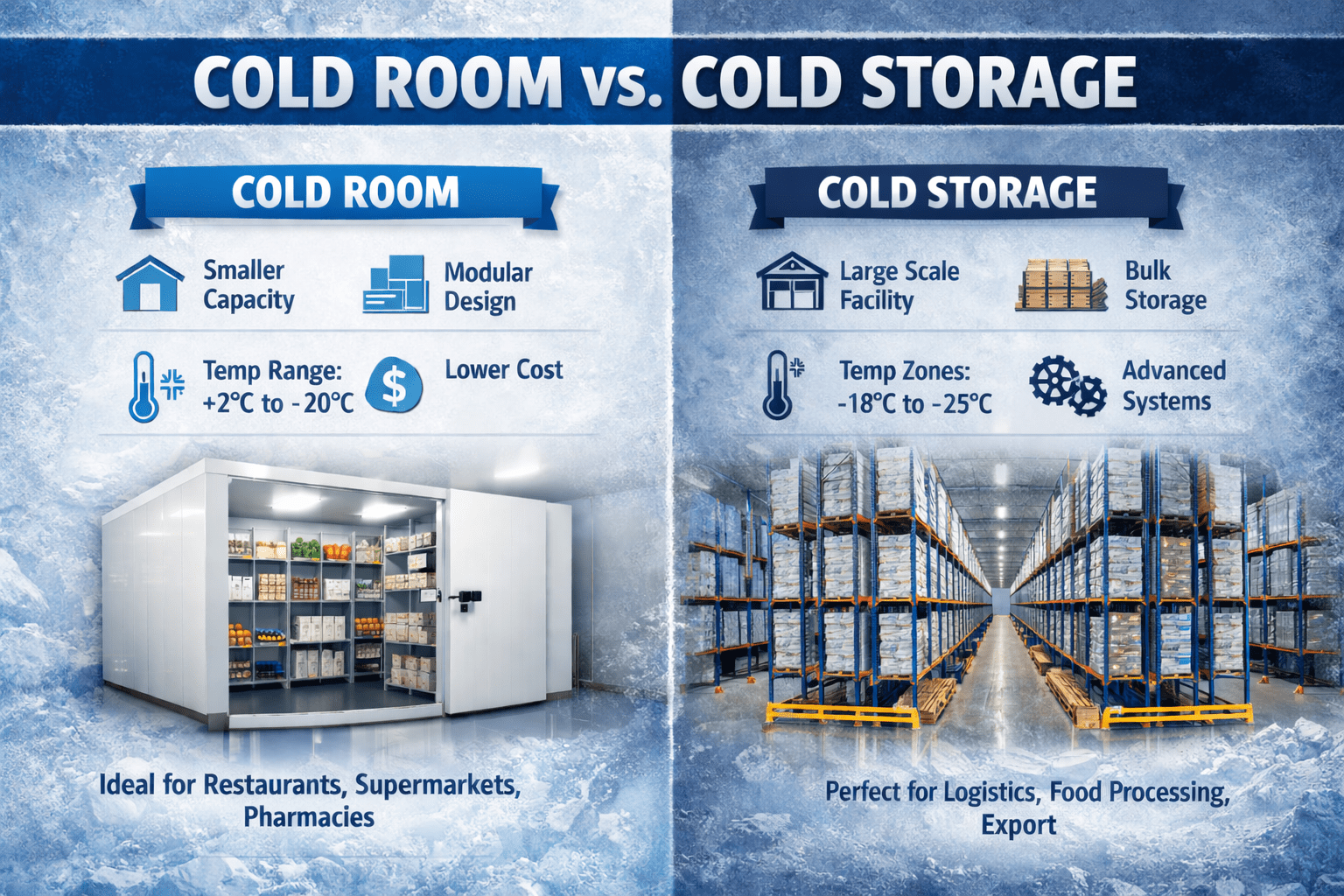 When businesses search for temperature-controlled solutions, one question comes up repeatedly: What is the difference between a coldroom and cold storage? Although people often use these terms interchangeably, they represent two distinct refrigeration concepts with different scales, designs, and applications.
Understanding this difference is critical whether you are a food processor, pharmaceutical distributor, hospitality operator, or logistics provider. Moreover, choosing the right coldroom manufacturer or cold storage manufacturer directly affects product safety, operating costs, compliance, and long-term reliability.
At Snowland Cooling Systems LLC, we work across the GCC and India, delivering both modular cold rooms and large-scale cold storage facilities. Therefore, this guide explains the topic clearly, practically, and without jargon—so you can make informed decisions.
Understanding Temperature-Controlled Storage: The Big Picture
Before diving deeper, it helps to look at cold rooms and cold storage as part of the cold chain ecosystem. Essentially, both solutions aim to:
- Preserve product quality
- Control microbial growth
- Extend shelf life
- Meet regulatory requirements
However, scale, complexity, and usage make all the difference.
What is a Cold Room?
A Simple Explanation of Cold Rooms
A cold room is a modular, enclosed refrigerated space designed to maintain a specific temperature range for short- to medium-term storage. Usually, cold rooms are installed inside existing buildings such as hotels, restaurants, supermarkets, laboratories, and hospitals.
In most cases, a cold room manufacturer custom-builds the room using insulated panels, refrigeration units, doors, and controls tailored to the client’s needs.
Key Characteristics of Cold Rooms
To understand cold rooms clearly, consider these defining features:
- Smaller capacity compared to cold storage warehouses
- Modular construction with PUF or PIR insulated panels
- Temperature range from +15°C to −25°C
- Quick installation and easy relocation
- Lower capital investment
Because of these advantages, cold rooms remain highly popular across retail, food service, and healthcare sectors.
Where Are Cold Rooms Commonly Used?
Cold rooms serve a wide range of industries, including:
- Restaurants, hotels, and cloud kitchens
- Supermarkets and hypermarkets
- Pharmaceutical outlets and hospitals
- Dairy farms and meat processing units
- Floriculture and horticulture facilities
As a result, demand for a cold room manufacturer in UAE, coldroom manufacturer in Oman, and cold room manufacturer in Bahrain continues to grow rapidly.
What Is Cold Storage?
Defining Cold Storage Facilities
Cold storage, on the other hand, refers to large-scale refrigerated warehouses designed for bulk storage over extended periods. These facilities often operate as part of industrial supply chains and logistics networks.
Unlike cold rooms, cold storage facilities require advanced engineering, robust civil structures, and automated systems. Therefore, working with an experienced cold storage manufacturer becomes essential.
Key Features of Cold Storage Warehouses
Cold storage facilities typically include:
- Very large storage capacity (from hundreds to thousands of pallets)
- Multiple temperature zones within the same facility
- High-capacity refrigeration systems
- Racking systems and material handling equipment
- Automation and monitoring systems
Consequently, cold storage is indispensable for export-oriented industries and large distribution hubs.
Industries That Rely on Cold Storage
Cold storage plays a critical role in:
- Food processing and agri-exports
- Frozen food manufacturing
- Pharmaceutical distribution and vaccine storage
- Meat, seafood, and poultry exports
- Third-party logistics (3PL) and cold chain operators
For these applications, businesses often seek a cold room manufacturer in Saudi Arabia, cold room manufacturer in Qatar, or cold room manufacturer in Kuwait with proven industrial expertise.
Cold Room vs Cold Storage: A Clear Comparison
Capacity and Scale
First and foremost, capacity separates cold rooms from cold storage:
- Cold rooms handle small to medium volumes
- Cold storage handles bulk and industrial volumes
Therefore, a restaurant needs a cold room, while a food exporter needs cold storage.
Construction and Design Differences
Next, let’s look at design and structure:
- Cold rooms use modular insulated panels and are often installed indoors
- Cold storage requires custom civil construction, heavy insulation, and structural steel
Because of this complexity, cold storage projects demand longer planning and execution timelines.
Temperature Control and Zoning
Although both solutions control temperature, cold storage facilities often offer:
- Multiple chambers with different temperature ranges
- Blast chilling and freezing zones
- Advanced humidity control
In contrast, cold rooms usually maintain one consistent temperature range.
Energy Consumption and Efficiency
Energy usage also differs significantly:
- Cold rooms consume less power due to smaller volume
- Cold storage facilities require high-capacity compressors and backup systems
However, a well-designed cold storage by a reputed cold storage manufacturer can achieve impressive energy efficiency at scale.
Cost and Investment
From a financial perspective:
- Cold rooms involve lower upfront costs
- Cold storage requires higher capital investment, but offers better ROI for large volumes
Thus, the decision depends heavily on business size and growth plans.
How Geography Influences Cold Room and Cold Storage Design
Why GCC Climate Demands Specialized Engineering
In regions like the Middle East, extreme heat creates unique challenges. Therefore, choosing a cold room manufacturer in GCC with regional experience is critical.
For example:
- UAE and Saudi Arabia require high-efficiency insulation
- Oman and Bahrain demand corrosion-resistant materials
- Qatar and Kuwait need energy-optimized systems for continuous operation
Snowland designs systems specifically for these climatic conditions.
Cold Room and Cold Storage in India
Similarly, India presents its own challenges—ranging from tropical humidity to cold northern climates. A cold room manufacturer in India must adapt designs to local power conditions, usage patterns, and compliance standards.
How to Choose the Right Manufacturer?
Should You Choose a Coldroom Manufacturer or Cold Storage Manufacturer?
Ask yourself these questions:
- How much product volume do you store daily?
- Do you need short-term or long-term storage?
- Is scalability important for your business?
If you need flexibility and quick setup, choose a coldroom manufacturer.
If you need scale and automation, work with a cold storage manufacturer.
What Makes Snowland Different?
Snowland stands out because:
- We design customized solutions, not generic systems
- We operate across GCC and India
- We offer end-to-end services—design, manufacturing, installation, and maintenance
Future Trends: Cold Rooms and Cold Storage Evolution
Smarter, Greener, and More Connected
Looking ahead, both cold rooms and cold storage are evolving rapidly. Key trends include:
- IoT-based temperature monitoring
- Energy-efficient compressors and refrigerants
- Automation and robotics in cold storage
- Modular expansion concepts
As sustainability becomes a priority, manufacturers like Snowland focus on low-energy, high-performance systems.


