
Cold rooms have become essential for businesses dealing with perishable products—whether in food & beverage, pharmaceuticals, logistics, or hospitality. But a common question people ask is: How does a cold room work?
At Snowland Cooling Systems LLC, a leading manufacturer of refrigeration and cold storage solutions, we believe in educating customers so they can make informed decisions. This in-depth guide explores the working mechanism of cold rooms, the components that make them function, and the science behind temperature control.
What Is a Cold Room?
A cold room—sometimes called a walk-in chiller, refrigerated chamber, or temperature-controlled storage—is a specially insulated room designed to maintain low temperatures for preserving perishable goods.
Cold rooms vary from a few cubic meters to large industrial storage facilities and can maintain temperatures typically between +18°C to –40°C, depending on the application.
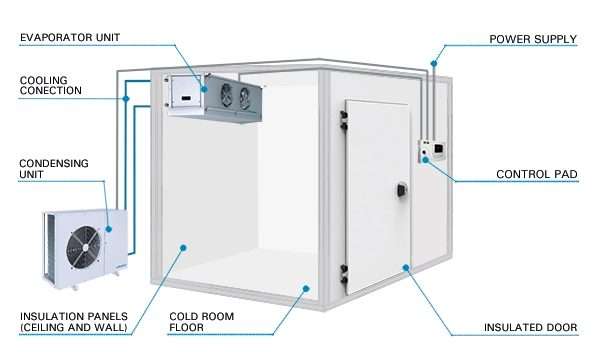


How Does a Cold Room Work?
To understand how a cold room works, let’s break the process into simple steps. A cold room functions on the principle of heat removal through a refrigeration cycle.
The Refrigeration Cycle
Also known as the vapour compression cycle, this system consists of four major components:
a) Compressor — The Heart of the Cold Room
The compressor pumps refrigerant gas at high pressure to the condenser.
It ensures a continuous flow of refrigerant throughout the system.
b) Condenser — Heat Rejection Unit
Here the high-temperature refrigerant releases heat to the surroundings and becomes a high-pressure liquid.
c) Expansion Valve — Pressure Regulator
This valve reduces the refrigerant pressure, transforming it into a cold, low-pressure liquid.
d) Evaporator — Cooling Coil Inside the Cold Room
The refrigerant absorbs heat from inside the cold room, producing the desired cooling effect.
Temperature Control | How Cold Rooms Maintain the Set Temperature?
Cold rooms work with digital or mechanical thermostats that monitor the internal temperature.
Once the temperature rises above the preset limit, the refrigeration cycle restarts automatically.
Sensors & Controls Included:
- Temperature sensors
- Humidity sensors
- Ammonia/CO₂ monitors (for industrial systems)
- Controller display panels
Insulation System | Why Cold Rooms Stay Cold?
Proper insulation plays a vital role.
Cold rooms are built using PUF/PIR insulated sandwich panels, which prevent outside heat from entering.
The tighter the insulation, the more efficient the cold room.
Insulation benefits:
- Reduces energy consumption
- Enhances cooling efficiency
- Ensures stable temperature
- Prevents condensation
Airflow & Circulation | How Cold Air Moves Inside?
EVAPORATOR FANS constantly circulate cold air throughout the room.
This ensures:
- Uniform temperature
- No hot spots
- Faster cooling
Optimized airflow is crucial for industries like dairy, pharmaceuticals, and meat processing.
Core Components of a Cold Room
Refrigeration Unit (Cooling Engine)
Includes compressor, condenser, evaporator, expansion valve.
Insulated Panels (Thermal Barrier)
PUF/PIR sandwich panels with cam-lock design.
Doors (Air-Tight Entry)
- Hinged or sliding
- Heater strips to avoid ice formation
Control Panel (Brain of the System)
Regulates:
- Temperature
- Defrost cycles
- Compressor operations
Flooring (Load-Bearing & Insulated)
Non-slip, hygienic, insulated floors designed to withstand heavy loads.
Why Cold Rooms Are Essential for Modern Businesses
Food Preservation
Maintains freshness of:
- Fruits
- Vegetables
- Dairy
- Meat
- Seafood
Pharmaceutical Storage
Perfect for vaccines, medicines, and chemicals requiring strict temperature control.
Logistics & Warehousing
Cold chain solutions for distribution companies.
Hotels & Hospitality
Bulk storage for kitchens, central production units, and catering services.
Types of Cold Rooms | Different Variants & Their Working Use-Cases?
Walk-In Chillers (Medium Temperature Room)
Ideal temperature: +2°C to +10°C
Used for vegetables, dairy, beverages, dry-aged items.
Freezer Rooms (Low Temperature Room)
Ideal temperature: –18°C to –25°C
Used for frozen foods, meat, seafood, ice-cream, bakery items.
Blast Freezers / Blast Chillers
Very fast cooling systems.
Temperatures can drop to –40°C.
Pharmaceutical Cold Rooms
Maintains highly precise temperature ranges.
Energy Efficiency | How a Cold Room Saves Power?
Key Features Contributing to Energy Savings
- High-density insulation
- Efficient compressors
- LED lighting
- Door heater cut-off
- Automatic defrost system
At Snowland Cooling Systems LLC, we engineer cold rooms with top-tier energy-saving technologies to reduce long-term operational costs.
How Snowland Cooling Systems LLC Builds High-Performance Cold Rooms
Customized Design
Every project is built according to temperature needs, product type, and storage volume.
Premium-Grade Materials
Use of advanced PUF/PIR panels, food-grade materials, and heavy-duty doors.
Latest Refrigeration Technologies
Incorporating:
- Scroll/reciprocating compressors
- Digital controllers
- Smart monitoring systems
Expert Installation & 24/7 Support
Our team ensures precise installation and uninterrupted service, thanks to our fully equipped cold room service vehicles.
Public business listings on UAE platforms, including ReachUAE, enhance transparency and ease of verification for customers.
Frequently Asked Questions about Cold Rooms
Cold rooms maintain temperature using insulation, evaporators, thermostats, and continuous cooling cycles.
Chillers: +2°C to +10°C
Freezers: –18°C to –25°C
A newly installed cold room takes 4 to 12 hours, depending on volume and temperature settings.
Yes, they are engineered for continuous operation with automatic cycles.
Based on:
- Storage capacity
- Type of goods
- Loading pattern
- Industry usage
Yes, periodic cleaning, coil maintenance, and gas pressure checks ensure long life and efficiency.
10–15 years with proper maintenance.


